IPSOS PRESS RELEASE- Favourability
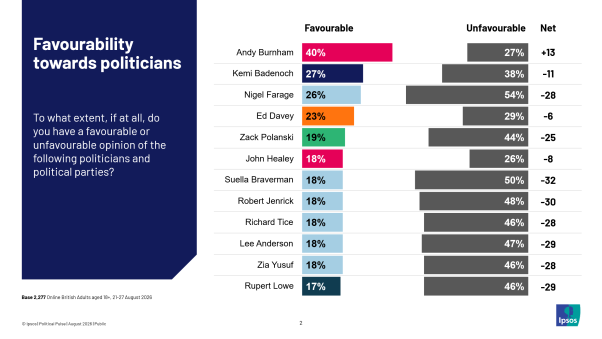
towards the PM has improved this month. 4 in 10 are now favourable
towards Andy Burnham (+8 from July), compared to 27% for Kemi Badenoch,
26% Nigel Farage, 23% Ed Davey and 19% Zack Polanski.
- Public
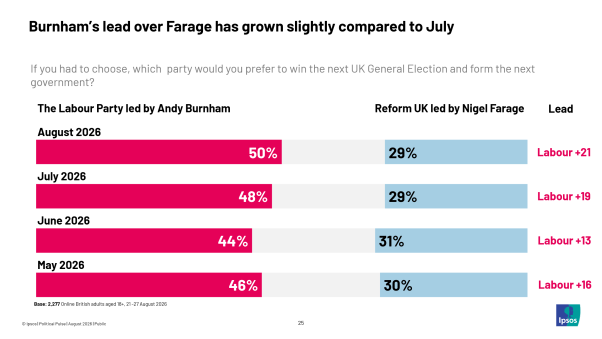
prefer a Burnham led Labour government to a Farage led Reform one (50%
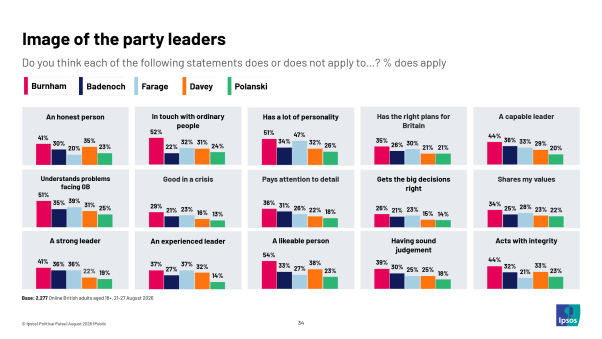
to 29%). Burnham is seen as more in touch with ordinary people and more
understanding of the problems facing Britain than Nigel Farage.
- Whilst
a majority of the public are unfavourable towards Nigel Farage, Reform
UK are still seen as the main alternative to Labour. Getting immigration
under control is seen as the main benefit of a Reform government.
London, UK.
New polling data from Ipsos in the UK, conducted 21–27 August 2026
explores attitudes towards leading politicians and parties in the run up
to Reform UK party conference. Polling was conducted before Zack
Polanski announced he was standing in the Holborn and St Pancras
by-election.
Favourability ratings
- 40%
are favourable towards Andy Burnham (+8pts from July), 27% unfavourable
(-4). Favourability ratings for other leading politicians are similar
to last month.
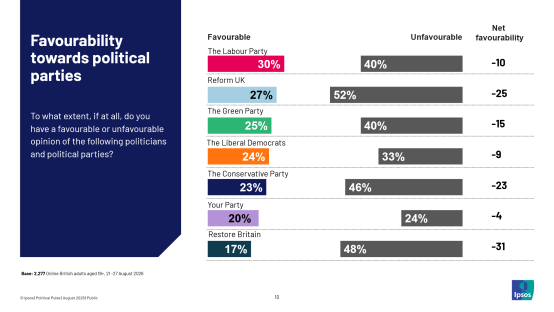
- Favourability towards the Labour Party has also improved this month. 30% are favourable (+5pts) and 40% unfavourable (-7pts).
- Ahead
of Reform Party conference, the public are more than twice as likely to
be unfavourable towards Nigel Farage (54%) as favourable (26%). Ratings
for the party itself are closely aligned – with 27% favourable and 52%
unfavourable.
- With
Zack Polanksi announcing his intention to stand in the upcoming Holborn
and St Pancras by-election, it is noted that 19% are favourable towards
Mr Polanski and 25% towards the Green Party generally. This compares to
40% and 30% for Mr Burnham and the Labour Party respectively. In London
40% are favourable towards Burnham and 28% Polanski whilst 38% are
favourable towards Labour and 36% the Greens.
Burnham vs Farage
When
presented with a binary choice, the public prefer an Andy Burnham led
Labour government to a Farage led Reform government by a margin of 50%
to 29%.
The
public were given a list of 15-character traits and asked which ones
were most important for making a good Prime Minister. The top 5 were
picked by 6 in 10 or more:
- Understanding the problems facing Britain (68%),
- Has the right plans for Britain (65%),
- In touch with ordinary people (62%),
- An honest person (61%)
- Gets the big decisions right 60%)
The
public were then asked whether these traits did or did not apply to
various party leaders. Notably, Andy Burnham leads Nigel Farage
significantly on being in touch with ordinary people (52% to 32%), being
honest (41% to 20%) and understanding the problems facing Britain (51%
to 39%).
Who do the public see as the main opposition?
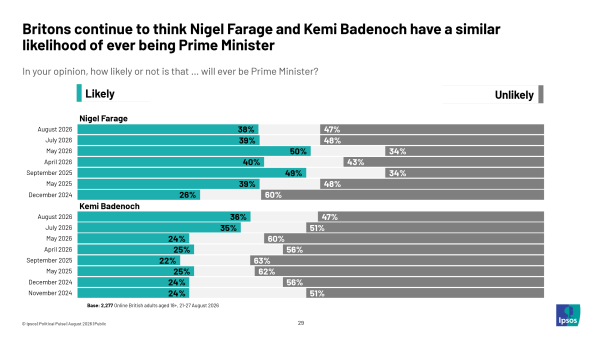
Kemi
Badenoch’s position related to Nigel Farage has improved over time. She
is now as likely to be seen as a future PM than Farage. This month 36%
say it is likely she will be PM in the future, 47% say it is unlikely.
Meanwhile, 38% say it is likely Farage will be PM and 47% say unlikely.
This is in sharp contrast to last September when 63% said it was
unlikely Badenoch will be PM and the public were more likely to think
Nigel Farage was likely than unlikely by a 14-point margin (48% to 34%).
With
that said, when asked which party are the main opposition to Labour,
meaning the most likely alternative government 37% still say Reform UK
and 27% say the Conservatives. Although the gap has narrowed
significantly from last September where Reform led by 22 points.
Benefits / drawbacks of a Reform government
When
asked what the main benefits would be from a hypothetical Reform UK
government the top 4 were that they would get immigration under control
(33%), they represent traditional British values (22%), they represent
real change for the country (20%) and they are in touch with what real
people think (20%).
The
main perceived negatives are ‘they would make the country more divided’
(44%), Nigel Farage would make a bad PM (40%), and they are too close
with President Trump (39%).
Direction of the country
Whilst
59% think the country is heading in the wrong direction and just 17%
say right direction, the proportion saying wrong direction has fallen 5
points since June and is significantly lower than the 71% recorded at
the end of last year.
Commenting on the findings, Keiran Pedley, Research Director for UK politics at Ipsos, said:
As
the Reform conference gets into full swing, it is clear that Andy
Burnham becoming Prime Minister has changed the political landscape. He
is better liked than other leading UK politicians and seen as more in
touch with ordinary people than Nigel Farage. At the same time, Farage
himself faces a challenge in that Kemi Badenoch’s poll ratings have
improved over time and she is now seen as likely as Farage to be Prime
Minister one day.
That
said, it would be foolish to write off Reform UK just yet. They are
still seen as the principle opposition to Labour for now and lead on the
most important issue facing the country – immigration. Which all
suggests they are not going away. Whether they are heading for
government, on the other hand, is another matter.
- For the full findings, please visit the Ipsos website.
- Ipsos
interviewed a representative sample of 2,277 online British adults aged
18+. Polling was conducted online between 21–27 August 2026.
- Data are weighted to match the profile of the population. All polls are subject to a wide range of potential sources of error.

reform + restore = 44 favourabiity
ReplyDeleteFavourability, not voting intention so maths don`t math.
Delete