Showing posts with label stopping up order. Show all posts

Friday, 24 April 2026

Proposed Stopping-up Order near Olympic Steps – the outcome of Brent’s application to the Court on 16 April

 Guest post by Philip Grant in a personal capacity


Willesden Magistrates’ Court. (Image from the Courts Service website)


At the end of my previous guest post about Brent’s application to stop-up two areas of highway, just to the south of Engineers Way near the Olympic Steps, I said that I would see the Council in Court on Thursday 16 April – and I did! Brent was represented by a barrister from Landmark Chambers, supported by the Council’s top Transport Officer and a Senior Engineer, and by Quintain’s Head of Planning (it was Quintain who had asked Brent to apply for the Section 116 Highways Act 1980 Order). I was represented by – me!


I arrived early for the 2pm hearing, and had an amiable discussion with the Brent team and their barrister, who had sent me, late that morning, a four page “Applicant’s submission” document and a fifteen-page copy of a decided Highways Act court case (R. v Leeds City Council, ex parte Spice) which they would be quoting from in support of the application. I don’t know whether they thought this would intimidate me, but I assured them that I had plenty of experience in dealing with Statute and Case Law from my working life.

Heading from the front page of the “Spice” High Court Judgment document.


The Magistrate hearing the cases listed for Court 4 did not appear until around 2.30pm, but it was not because he was having a long lunch. It turned out that he had also only received the latest documents from Brent Council that morning! When we got to “our” Case 6, around 3pm, he asked me whether, in the circumstances, I would like an adjournment, so that I could consider these extra documents, and a one centimetre thick “Application Statement” (“AS”) which Brent had submitted to the Court on 7 April. I was only passed a copy of this by the barrister at the start of the hearing. I thanked him for the offer, but said that I was happy to proceed, as it was in everyone’s interests for the matter to be resolved without further delay.


Brent Council’s “Application Statement” document.


The barrister presented Brent’s application, setting out that the Council had complied with all of the procedural requirements for giving notice, and stating that the Section 116 Order was needed so that responsibility for maintaining the old areas of unnecessary highway could pass to Quintain, who had since developed the land. She referred to photographs in the AS showing the locations of the highway, including those for the eastern hatched area pictured here:


The “eastern area” photos from Brent’s Application Statement.


The barrister’s presentation went on for around twenty minutes, and then the Magistrate asked several questions. One was about the assurance which Quintain had entered into with Brent, which was claimed to reinforce the Section 106 planning condition which allowed public access to the land which was the subject of the application. He was particularly concerned with the wording in the final sentence of Quintain’s letter of 30 March 2023, a copy of which was at tab 11 in Brent’s AS. That sentence said:


‘Although the land will be stopped up, Quintain can confirm that it will remain open to the public and remain free for people to pass and repass over but for the avoidance of doubt there is no intention by Quintain to re-dedicate the land as highway and public access would be on a permissive basis only.’


Quintain’s 30 March 2023 letter (with personal names deleted for privacy).


The Magistrate felt that ‘on a permissive basis only’ suggested that the public would only have a “licence” to cross the land, not a firm legal right. Quintain’s Head of Planning said that was not what they intended – the company simply wished to ensure that parts of the public space could be closed off for maintenance on the occasional day when this might be necessary. There was a short break while a revised final sentence was drafted, which satisfied the Magistrate’s concerns.


I was then invited to present my case objecting to the application. I asked whether the Magistrate had a copy of the photographs evidence document, which I had sent to the Council in January, and had emailed a copy to the Court Office the previous week. He looked in his online case file and said that he had a copy, which he felt would be very useful. I then set out my arguments, that the application was wrong in law. 


Extract from the application Plan, showing the hatched areas.


Although I agreed with the Council that it was sensible to resolve the residual problem of who was responsible for maintaining the hatched areas of land, they did not need a Section 116 Order to do that. The proposed Order dealt with the land as it is now, and it was necessary for the public to continue to have ‘a right to pass and repass, either on foot or dependent on suitability in a vehicle’ over this land. The draft Order sought the Magistrate’s authorisation to stop-up this highway ‘for the purpose of all traffic and all public rights of way [to be] extinguished.’ But he could only sign the Order if the area of highway was unnecessary.


Two ‘key principles’ from Brent’s “Applicant’s Submission” to the Court.


I took the Magistrate through the photos I’d taken in January, one by one, and referring to the “Applicable Test” section of Brent’s submission, asked whether highway, such as Olympic Way East, was ‘unnecessary for the sort of purpose for which Justices would reasonably expect the public to use that particular way’?


One of my evidence photographs, showing a car crossing the hatched area into Olympic Way East.


I also made the point that if the Magistrate did sign the Order which Brent had prepared, it would create two completely contradictory situations for the hatched areas. Under the planning condition and the Quintain letter of assurance the public had the right to cross that land. Under the proposed Order the public’s legal right to cross those small areas of land would be extinguished. Although the public would see no practical change in their use of the land for now, it could create a legal nightmare in future. Public use of the hatched highway areas was necessary, and it was the Section 116 Order which was unnecessary.


The Magistrate asked me whether I was aware of Section 142 of the Road Traffic Regulation Act 1984. I admitted that I had not read or considered it. He said that it was possible for a road not to be a “highway”, and from looking at my photos it appeared to him that Olympic Way East was not a highway, but a ‘road to which the public has access’. Similarly, the footway areas, such as that in front of the Olympic Steps, were not highway, but public space to which people had access.


The Magistrate said that he would retire to consider his decision, but would come back and give it verbally when he had done so. We waited in Court 4 for at least half an hour until we rose as he returned at around 4.30pm. In summary, he agreed with Brent that the legal status of highway was not necessary for the two hatched areas, so he would sign a copy of the Plan. However, he commended me for my public spiritedness in standing up for the legal right of the public to cross and recross those areas, and said that he would not sign the Order authorising the stopping-up of those unnecessary areas until its wording had been changed, to remove the reference to extinguishing all public rights of way.


Both sides left the Court satisfied with the outcome, and Council Officers emailed me a revised draft of the Order the following morning, inviting my comments or agreement. I recommended tidying up the wording over ‘highway maintainable at the public expense’, and suggested that to avoid any confusion over the previous and present uses of the hatched areas they should be described as ‘disused’ and ‘now being part of .…’ I’m pleased to say that my suggestions were accepted, and you can see the difference between the original and final versions of the Magistrate’s Order here:


Opening paragraph of the Section 116 Order document.

Closing section of the Section 116 Order document.


If the Notice last December about Brent’s application for a Stopping-up Order had included the final wording, I would not have objected to it. So much time and effort, over the past few months, for myself and Council Officers, could have been avoided. I think this underlines the point I made in my March 2026 guest post, that if Brent had (as it used to) a General Purposes Committee consisting mainly of experienced back-bench councillors, who could take the time to question Officers and get things right, rather than Cabinet members rushing through an agenda at 9.30am ahead of a 10am Cabinet meeting, the Council could avoid making some of its bad decisions.


There have been too many bad decisions made by Brent Council over the past decade or more, some of them wasting millions of pounds. I hope that the elections on 7 May will see a change in the balance of power, and bring in a majority of councillors willing to work together, across party lines where necessary, to improve scrutiny and decision-making. Scrutiny at Brent Council has been ineffective for too long, mainly because too much power has been in the hands of the same Leader. 


I have done what I can, on a variety of issues, to try to hold Brent Council to account, including as an honorary member of Martin’s unofficial “Committee” for around a dozen years, but it is time for official and effective scrutiny to pass back to elected councillors, where it belongs. I hope that readers will consider that when they decide who to vote for in May’s local elections.


Philip Grant.

Friday, 27 March 2026

Proposed Stopping-up Order near Olympic Steps – here we go again, and why this reflects what is wrong with Brent Council decision-making.

  Guest post by Philip Grant in a personal capacity 

Legal Notice from the “Brent & Kilburn Times”, 19 March 2026.


My guest post on 1 January opened with an image like this one, giving notice of a Magistrates’ Court hearing on 22 January at which Brent Council would be applying to stop-up (that is, to extinguish the right of pedestrians and vehicles to pass across) two areas of highway near Engineers Way, and close to the Olympic Steps at Wembley Park. An update to a subsequent article, Does Brent Council really want to embarrass itself in Court?, reported that the Council had asked for that hearing to be adjourned. 


Hopes that common sense would prevail were dashed when a Council Officer informed me, a couple of weeks ago, of a new hearing date on 16 April. I waited until the formal notice (above) had appeared in our local newspaper, before responding to it:


‘I have seen the Notice in yesterday's "Brent & Kilburn Times" about the new hearing date of 16 April at 2pm for the Council's Section 116 application. As requested in the Notice, I am writing to formally advise you that I intend to appear at this Willesden Magistrates' Court hearing, to object to the application for a stopping-up Order.


The grounds for my objection are that the application under Section 116 is wrong in law, because the two areas of highway shown on the Plan are not "unnecessary".


I will use the illustrations in the document "Brent Council’s proposed Engineers Way S.116 Stopping-up Order areas in pictures", which I supplied you with a copy of on 12 January 2026, as evidence that it is necessary for pedestrians and vehicles to pass across the areas of highway which the Council seeks to stop-up. You should ensure that whoever will be representing Brent Council at the hearing has a copy of that document.


Even at this late stage, it would be possible for the Council to withdraw its application, as you must realise that it has little hope of success, on the basis of the facts and law. Please let me know, as soon as possible, if the application is withdrawn. Thank you.’


I received two brief responses from Council Officers:


‘Thank you for letting me know of your intention to attend the stopping up order court hearing. I can confirm, as explained in our previous correspondences, the Council is intending to request the magistrate to approve this order under section 116 of the Highways Act 1980.’


‘I can confirm that we have a copy of your submission from 12th January "Brent Council’s proposed Engineers Way S.116 Stopping-up Order areas in pictures" and will ensure our barrister has sight of the document prior to the hearing.’


So not only are the Council going ahead with the application, they will be represented in Court by a barrister (I will be representing myself!). Hopefully, Quintain Ltd will be paying the barrister’s fee, as apparently, they were the ones who asked Brent to make the application in the first place. 


View from the Olympic Steps, showing that one of the areas Brent seeks to stop-up (in red)  would block the entrance to Olympic Way East, and impede pedestrians from using the Engineers Way crossing between Olympic Way and the Olympic Steps.


You only need to look at the areas the proposed stopping-up order would apply to, as shown by even one of the images (above) in the evidence document I supplied in January, to see that it is necessary for pedestrians and/or vehicles to pass across them. Yet Council Officers and an important Council committee are supposed to have considered the details before agreeing that an application for a Section 116 Order should be made to the Court.


The committee involved was Brent’s General Purposes Committee, at a meeting as long ago as 7 March 2022. This is one example, of many possibles, which illustrates how the decision-making processes at Brent Council have deteriorated over the past decade or so. This can lead to ill-considered decisions, which often end up wasting money (sometimes £millions) and to poor services. In this case, it was obvious to me as soon as I saw the plan showing the areas involved that they were not “unnecessary”, so why was it not obvious to the decision-makers?


I wrote in October 2016 about the way in which Brent’s General Purposes Committee, which used to be a strong group of senior “backbench” councillors, had been “hijacked”. The title of that article was: Does Councillor Butt have too much power?. Here is an extract from it:


‘[Brent’s] Constitution (in its own words) ‘…sets out how the Council operates, how decisions are made and the procedures which are followed to ensure that decision making is efficient, transparent and accountable to local people. Some of the procedures are required by law, while others are a matter for the Council.’


“Responsibility for Functions” is an important area, which should mean that there are “checks and balances” to ensure that power is shared across the Council, so that no single person or group within it has too much (to guard against that power being abused). The Constitution gives the Leader, or the Leader together with the Cabinet, considerable powers, but there are also ‘functions which cannot be exercised by the Cabinet’, ‘functions not to be the sole responsibility of the Cabinet’ and ‘functions that may only be exercised by Full Council’.


One area of particular concern is the General Purposes Committee, which ‘carries out a number of functions on which the Cabinet cannot take decisions, including public rights of way, setting the Council Tax base and approving staffing matters’.  The committee has eight members, and the Constitution used to say that at least one of these must be a member of the Executive (the previous title for the Cabinet). That proviso, which gave a very strong hint that most of the committee should be made up of back-bench councillors, has been removed, and for the past few years seven of the eight members have been Cabinet members, with the official Opposition Leader as the eighth.


Cllr. Butt is Chair of the General Purposes Committee, and of its Senior Staff Appointments Sub-Committee. This has given him considerable influence over the Council’s senior staffing structure, who is appointed to the Senior Officer posts, and the terms on which they are appointed.’


Whereas the General Purposes Committee used to hold “full length” meetings, when councillors would discus and decide matters publicly and transparently, they now start just half an hour before the Monday morning Cabinet meetings.  There were six substantive items on its agenda for the meeting on 22 March 2022. The minutes show that it began at 9.30am, and record that ‘the meeting closed at 9.49am’! 


I did follow-up my October 2016 guest post with an email to Brent’s then Chief Executive, who chaired the Council’s Constitutional Working Group (of which the Council Leader is also a member), suggesting that it:


‘should consider ways to ensure that the functions of the General Purposes Committee and its sub-committees are carried out independently of the Council Leader and the Cabinet. This is not just something which affects the present personnel, or situation on Brent Council, but a question of good governance.


The Leader and Cabinet already have considerable powers in those roles, and yet there are more than fifty other elected councillors whose knowledge and experience could contribute to the functions carried out by General Purposes Committee, if the majority of seats on that committee, and its Chair, were to be reserved under the Constitution for members who are not in the Cabinet. I believe that this would also ensure a better balance of power within the Council as a whole.’


The reply I received to my detailed email was short:


'Dear Mr Grant


Thank you for your email. The Chief Executive notes your concerns about the constitution of the General Purposes Committee. The Chief Executive and I consider that the composition of the Committee is satisfactory from both a legal and operational perspective.


Best wishes,


Chief Legal Officer'


Both the Chief Executive and Chief Legal Officer at that time had been chosen by the Senior Staff Appointments Sub-Committee, chaired by ………. you’ve guessed who.


Would a properly (in my view) constituted General Purposes Committee, which could spend more time considering reports presented to them by Officers, and would have had time to look at the plan which was one of the appendices to the Stopping-up Order Report, have agreed the recommendation ‘to approve the submission of an application to the Magistrate Court’? I can’t be sure, but I believe it was an avoidable error, which has wasted a lot of Council Officer time.


Willesden Magistrates’ Court. (Image from the Courts Service website)


We will find out whether it really was a bad decision when I see Brent Council in Court, on the afternoon of Thursday 16 April!


Philip Grant.

Thursday, 1 January 2026

Why does Brent want to Stop-up “highway” near the Olympic Steps?

 Guest post by Philip Grant in a personal capacity. I would like to take this opportunity to thank Philip for his many valuable contributions over the past year, 


I don’t make New Year resolutions. If I did, one of them would probably be not to get into any new entanglements with Brent Council in 2026. And I would have broken it already, after seeing this Legal Notice in the 18 December edition of our local newspaper.


The Notice said that the Council would be applying for a Stopping-up Order for an area of highway, including pedestrian areas near the Olympic Steps. That seemed an odd thing to do, as such an order would extinguish all rights of way over that land. I’m interested in the history of Wembley Park, and actually wrote an illustrated article, The Olympic Way Story, for Brent Council in 2017! I wanted to see what area of land the application affected, but to do that I would have to go to the Civic Centre ‘during normal office hours on Mondays to Fridays.’


A copy of the Notice, on a lamp post at Engineers Way, 22 December 2025.


So on Monday 22 December I went to the Civic Centre to inspect the Plan and Draft Order, and did see one notice about the proposed stopping-up on a lamp post. But when I asked to inspect the documents, staff in the Library did not know anything about them, and after a half-hour wait to be seen at the Civic Centre’s “Welcome Desk” (reception), staff there did not know about them either, and could not find them in the cupboards behind the desk.


I sent an email to the address of the Council Officer listed in the Notice as soon as I got home, and that Officer in Brent’s Development Services department sent me pdf copies of the documents the following day, also saying that they ‘were given to both Civic Centre reception and Wembley Library on the 12 December 2025 for public viewing.’ As I believe it is important that local residents have easy access to the Plan and Draft Order, I will ask Martin to attach copies at the end of this article.


When I saw what was involved in the Order Brent would be seeking from Magistrates on 22 January, I could not understand the reason for it. Why would they want to stop people walking over that land, or vehicles from going between Engineers Way and Olympic Way East or West? I felt it had to be questioned, and if necessary challenged! My 22 December email had been copied to Brent’s Public Realm Director (who had signed the Notice), and as his “out of office” message said that he was away until 29 December, this is the main section of the email I sent him first thing that morning:


‘[Your colleague] kindly sent me the documents for this Stopping-up application on 23 December, but that does not detract from the fact that those documents were not freely available for me to inspect, during normal office hours at Brent Civic Centre on Monday 22 December, as they should have been under your Notice of 11 December 2025.


Please let me know whether you still intend to make the Council's application at the hearing on 22 January 2026, or whether you will be issuing a fresh Notice, with a new hearing date, ensuring that the necessary documents are available to inspect, at a designated location within the Civic Centre (as suggested in my email to you of 22 December).


I note that the Plan showing the hatched areas which the proposed Order plans to stop-up was prepared for Quintain Limited in June 2025. Can you confirm, please, that the London Borough of Brent is making the application on behalf of Quintain Limited, and if so, on what basis is the Council doing that (and at whose expense)?

This is the relevant extract from the Plan (with the words "Olympic Steps" added for clarity):


The draft Court Order states that the application is being made because the area(s) 'shown hatched black on the plan attached drawing number TPHS-434-DR-00 should be stopped up on the ground that it is unnecessary.'


Please let me know the reasons why you consider those hatched areas to be unnecessary for pedestrians and/or vehicles to use in future. I have to ask that, because I cannot understand why that should be the case, as stopping-up would extinguish 'all traffic and all public rights of way ... over the said area of highway.'


From my knowledge of the area, including walking over some of the "hatched" areas myself on my visits to Wembley Park, I can't understand why it should be unnecessary for:


·      vehicles to pass, at least on some occasions, to or from Engineers Way and Olympic Way East and Olympic Way West, including to access the undercroft area for community and other events;

·      for pedestrians using the Engineers Way crossing from Olympic Way to have unimpeded access to the Olympic Steps, in both directions, especially when large events are taking place at the Stadium;

·      for pedestrians using the Engineers Way crossing from Market Square, beside the Civic Centre, to have unimpeded access to Wembley Park Boulevard (and back, on their way from Wembley Arena, the LDO and beyond towards Wembley Park Station);

·      for pedestrians coming west along Engineers Way from Canada Gardens, the University of Football Business and other developments, to have free use of the existing wide pedestrian area at the foot of the Olympic Steps, and the existing but narrower pedestrian area as they approach Wembley Park Boulevard and Arena Square.


The areas which your application proposes to stop-up were designed to be the way they are, as part of Quintain's Masterplan for Wembley Park. I can't see why the need for them should have changed, particularly given the growing number of people living in the area, and the increased number of large events at the Stadium, since that Masterplan was drawn up, and approved by Brent Council.


Unless you can provide a very strong justification as to why those hatched areas on the Plan are now unnecessary, I think that this application should be withdrawn. Best wishes,


Philip Grant.’


In case you have difficulty in visualising the areas the Council proposes to stop-up from the plan, I have marked them in red on this Google Maps satellite view extract:


The Public Realm Director quickly sent a holding reply, to say that he would consult colleagues on their return before sending a full response, and this is what he wrote when he sent that:


‘Dear Mr Grant,


The land proposed to be stopped up was the former bell mouth into Green Car Park and a sliver of land along the southern footway of Engineers Way located east of Wembley Park Boulevard.


The stopping-up was requested by Quintain as the area shown in hatch was deemed to be in the line of their Hostile Vehicles Mitigation bollards (an important counter-terrorism installation). These bollards are installed by Quintain, and the future maintenance will also be with them. The staggered nature of the former highway land would not serve any purpose as highway maintainable at public expense and so there is value in eliminating an ongoing burden on public finances.


I confirm Quintain has met all expenses in this stopping-up process. The original application was made around five years ago and the legal process, the statutory undertakers utility clearance and the obtaining of a court date have taken a considerable amount of time.


The stopping-up does not in any way impede public access to Olympic Steps nor to the access roads Olympic Way East and West. The stopping-up process will not in any way change the layout of the public realm that is currently in place. All existing pedestrian and vehicular access will remain unchanged, and we have had written assurance from Quintain to this effect. The purpose is simply to allow Quintain to maintain their land in future years to the same standard as the rest of the Wembley Park estate.


We have now been given a court date for the hearing on the 22 January 2026 at 2 pm. Therefore, the notice of intent and the draft order was publicised by our lawyers on the 15 December allowing sufficient time for the statutory notice period.


As part of the notice process, notices and a draft order were published in the local press; the same was posted on-site and a copy of the notice of intent, draft order and the stopping-up plan were left with Brent Civic Centre welcome desk and at the Wembley Library on the 12 December.


Following your email, my colleague contacted the Civic Centre welcome desk and requested that the documents must be available for public viewing until the end of the statutory notice period, i.e. 19 January 2026.


I regret you couldn’t view these documents when you visited. However, they were left with the front of house staff on Friday, 12 December 2025.


The stopping up process is a lengthy process and the court date is harder to obtain. Therefore, asking for an alternate date is not a viable option and would require substantial officer time.


I can advise, however, that if you are not satisfied with our process, then you can, of course, make representation at the court. 


I hope this is helpful background. Kind regards,


Director of Public Realm.’


The Olympic Steps and Stadium, from Engineers Way
(with people walking across a strip of land that could be stopped-up!)


If you have managed to read this guest post all the way through to here, thank you. What do you think of this proposed Stopping-up Order, and the Council’s explanation of why they are applying for it? If you have any views, please feel free to share them in the comments below.


I think it is important that local residents are aware of this application, by Brent Council on behalf of Quintain Limited. Having considered it myself, I believe that the proposed Order is unnecessary, and a misuse of Section 116, Highways Act 1980. I will try to persuade the Council Officer to withdraw the application, and will include my reasoning for that (as the text of an email I will send to him) for information in the comments section.


For now, though, I will wish all “Wembley Matters” readers a Happy New Year! There will be lots of interesting and important things happening in Brent in 2026, and this blog website is a very good source for information about them, so please keep following it.


Philip Grant 


Thursday, 9 June 2022

Scrutiny Committee upholds Alan Lunt's decision on 1 Morland Gardens (Altamira)

Members of the public and opposition councillors presented at the Call-in Scrutiny Committee over a Key Decision on the  controversial 1 Morland Gardens made by the Director of Regeneration. 

Philip Grant’s presentation to R&PR Scrutiny meeting on 9 June:


The Key Decision Report briefly mentions the Council’s need to have ‘all the necessary statutory approvals in place’. It doesn’t have those approvals yet, and may never get them.


In January 2019, Officers were told they’d need to stop-up the highway outside 1 Morland Gardens, and appropriate the land, if they wanted to build on it. They failed to consider what the effect of this would be, and have continued to do so.


I’m one of several people who’ve objected to the proposed Order, for environmental and public health reasons.


Pedestrians who currently use footpaths across the land are shielded from Hillside and Brentfield Road by the trees of the Community Garden. Stopping-up and building over the land would force them to walk beside that junction instead.


Planning application documents showed dangerous levels of NO2 and particulates there. This meant that all windows in the new building, up to the second floor, must be sealed, with fresh air provided by mechanical ventilation. No thought was given to people walking past!


The health risks to local people, especially children, who’d have to walk through this polluted air, are a strong reason why objections to the proposed Order may well be upheld.


That will be decided by an independent Inspector, and it’s likely to be next year before the Council knows the outcome.


Melvyn Leach

Presentation to Brent Council R&PR Scrutiny meeting on 9 June 2022


After being deputy headteacher in a Brent secondary school, in 1994 I was appointed as the first head of Brent Adult College, now Brent Start, that opened at 1 Morland Gardens.  I hope to persuade you not to allow its unnecessary demolition.


Brent 
Council and Harlesden City Challenge invested significantly to regenerate the site into a tastefully restored heritage building, used as a successful new adult education centre. At that time decision-makers in Brent Council showed huge pride and value in preserving the local and architectural history of 1 Morland Gardens.


1 Morland Gardens is an attractive listed heritage asset. My experience as a teacher has shown how significant such buildings are in helping students relate to, and learn about, the lives of people who lived and worked in Brent in the past.


If the Council can’t get approval to build on the extra land, it could draw up alternative plans that retain the Italianate villa as part of a modern development.


Heritage sites like this can show young people the importance of Brent Council promoting and enabling conservation, alongside essential regeneration. Political Leaders need to set an example of the value of such special assets. Children learn by example. 


The heritage building and educational facilities are too valuable to demolish. Unless it’s absolutely certain that the proposed redevelopment can legally go ahead, I urge you to prevent the unnecessary loss of 1 Morland Gardens and the community garden.


Alan Lunt, Director of Regeneration, apologised for the delay in the stopping up orde for 1 Morland Gardens and assured the Commitete that it would not happen again.  Cllr Rita Conneely, Chair expressed the strong opinion that the Committee expected that strong checks and balances should be put in place  to ensure that this was the case.

One comment by Alan Lunt that the difference between Council rents and London Affordable Rent (the scheme is the latter) was 'only' £10 a week (£520 a year) was challenged on Twitter with this reference LINK but accepted at face value by councillors and quoted by them.


Emphasising that this was a two stage project, Stage 1 Design and Stage 2 Build, Lunt said that the Design Stage would cost £1.1m, but if a contract was not signed and work started by August, if only a hoarding around the site, the Council stood to lose the £6.5m GLA grant towards affordable housing. Any delay would mean a significant rise in costs, Someone suggested 13%, because of current inflation in materials.

The Adult College had already been moved to the Stonebridge Annex site (previously occupied by Stonebridge Primary School) and the buildings were empty.  He undertook that no demolition would take place on the Altamira heritage site until a Stopping Up Order was in place, although the Council were ready to start on demolition.

Lunch said that it was highly unusual for the public to object to such Orders and the normal process was objections from utilitiy  companies until negotiations had taken place for access or diversion of their resources.  The Council was using the right powers for the right reasons and issued Stopping-Up-Orders about six times a year. None had been refused but if the London Mayor did so it would go the the Planning Inspectorate with a lead-in time of about 6 months.

Objectors had raised concerns that the plans for the site did not conform to the Council's commitments on air quality and the climate emergency. Mr Lunt maintained that the development would reduce pollution and any increase in public exposure using the revised pedestrian route would be 'miniscule'. In any case the extension of the ULEZ (Ultra Low Emission Zone) the ban on new petrol cars in 2030 and hybrids in 2035, would reduce emissions.

There was only a minor contribution to the discussion by Cllr Mili Patel, Cabinet lead for Finance and Resources, who emphasised the benefits of the scheme for the local Stonebridge community in terms of education, 'affordable' housing and a community cafe. 

 Some of the issues to do with loss of mature trees and the heritage building were deemed not to come under the Committee's remit as they had been dealt with by the Planning Committee.

The Scrutiny Committee vice chair, Cllr Janice Long, expressed the view that 'life is a risk' and that the potential gains of the scheme were a risk worth taking. 

She was disparaging about the City Challenge community garden on the site and could not imagine why anyone would want to sit in such an unattractive area. Alan Lunt had said that the garden was being moved rather than destroyed and that although mature trees would be lost they would be replaced by semi-mature trees rather than saplings.

The Committee voted to support the following option set out in the Officer's Report:

The Committee does not wish to refer the matter back to the decision maker or to Council, at which point the decision is deemed to be confirmed and takes effect immediately following the meeting.

It is worth noting that the meeting was well-chaired and the process explained with opportunities for all to contribute. There was an absence of any political point scoring. New Labour councillor Mary Mitchell acknowledged that the Call-in was based on legitimate concerns.

A promising start to a new era of effective scrutiny?


NOTE

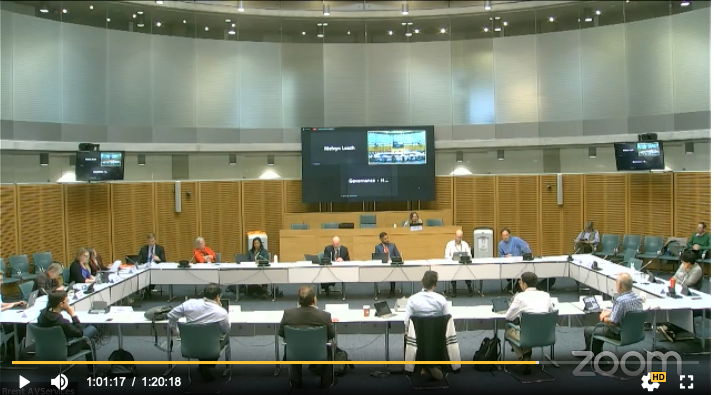
Once again there were technical hitches. The public watching on the Live Feed were able to hear Melvyn Leach on zoom but the Committee were not, with the result that his presentation had to be read out.


Another problem was that the live feed camera maintained a wide view of the whole committee during the webcast so it was sometimes difficult to know who was speaking unless their name was clearly said when they were called upon to speak. Apologies for any mis-attributions.


  1.