Saturday, 5 September 2026

A temporary end to Brent's 'Dirty Weekends'? Scrutiny discusses call-in of the proposed variation of the Veolia contract and a possible review before implementation of measures.


Dump on Public Right of Way 27 between St Andrew's Road, Kingsbury and Grade 1 Listed Old St Andrew's Church. An example of an unregistered space, long a dumping ground.


Scrutiny Committee voted last night not to refer back the proposed variation of the Veolia contract. Conservative and Labour councillors outvoted their Liberal Democrat and Green peers. 

The call-in by Liberal Democrats and a Green  member wanted a review of Veolia performance before implementation of the variation measures, as the Lead Member, Cllr Promise Knight, had not consulted with councillors over the issue. As the Lead Member was not present Cllr Butt substituted for her.

Cllr Paul Lorber presented the call-in and began by challenging the sum of £1.54m quoted as the cost of the 12 month variation. It included 20% VAT. As public bodies spending for the public good do not pay VAT or have it returned - the true cost was actually £1.2m. 

Before the implementation of the additional measures he said there should be a Review that asked: 

What is wrong? {with waste and litter system]

 How do we improve it?

How much does it cost?

What can we afford? 


After Cllr Lorber and other councillors had spoken about the level of complaints from residents about litter and fly-tipping the Chair, Cllr A.Patel, drew attention to the 'disconnect' between that experience and a procurement report that said that Veolia was performing well and feedback was positive, satisfying the contract's KPIs (key Performance Indicators). Cllr Mary Mitchell remarked that perhaps this meant that the KPIs were wrong.

Cllr Butt said that the contract in 2023 was devised at a time when there was limited funding and even now councillors could not expect a gold-plated service. Veolia could not be expected to do things for free.  The Council were plugging the gaps with the variation operating over 12 months and then could evaluate and decide what was possible over the next period. He seemed a little confused because at one point he said, 'This is not a variation of the contract'. (2.41 in above video)

Environment Officer Chris Whyte pointed on that the latest contract came to an end in 2031 and that for such a large and complicated contract a review involving all parties would start in 2028 ahead of the procurement.


Cllr Butt said that the interim measures would address Brent's 'dirty weekends' when littering and flytipping took place but was not addressed until work resumed on Monday. Weekend and late night working would deal with some of the persistent problems. Chris Whyte said that the clear-up from weekend dumping lasted through to Wednesday so it was only on Thursday and Friday that Brent streets were really clean.

Questioning by Cllr Paul Ryan on the money available this year drew the information that an additional £3m, minus the £1.2m,  for public realm was available in this year's budget. Members could make suggestions on how this could be used but the process for doing so was not clear.


Friday, 4 September 2026

Bon Jovi Concert road closures and bus diversions Sunday 6th and Wednesday 9th September


IPSOS POLL: Burnham bounce continues with public more favourable towards PM than other leading UK politicians

 In the light of the upcoming by-election in our neighbouring borough of Camden I thought readers might be interested in this latest iPSOS Poll that took plce between the 21st and 27th of August,

IPSOS PRESS RELEASE
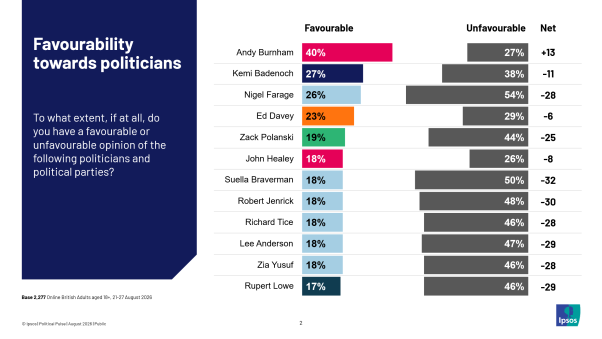
  • Favourability towards the PM has improved this month. 4 in 10 are now favourable towards Andy Burnham (+8 from July), compared to 27% for Kemi Badenoch, 26% Nigel Farage, 23% Ed Davey and 19% Zack Polanski.
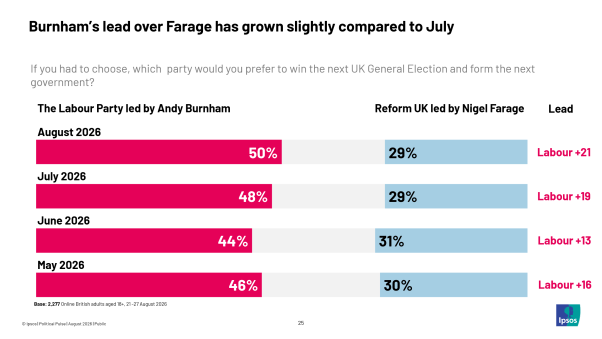
  • Public prefer a Burnham led Labour government to a Farage led Reform one (50% to 29%). Burnham is seen as more in touch with ordinary people and more understanding of the problems facing Britain than Nigel Farage.
  • Whilst a majority of the public are unfavourable towards Nigel Farage, Reform UK are still seen as the main alternative to Labour. Getting immigration under control is seen as the main benefit of a Reform government.

London, UK. New polling data from Ipsos in the UK, conducted 21–27 August 2026 explores attitudes towards leading politicians and parties in the run up to Reform UK party conference. Polling was conducted before Zack Polanski announced he was standing in the Holborn and St Pancras by-election.

Favourability ratings

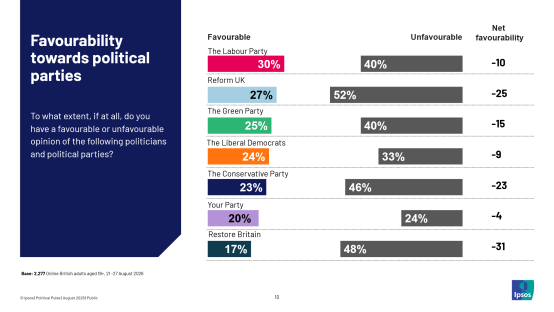
  • 40% are favourable towards Andy Burnham (+8pts from July), 27% unfavourable (-4). Favourability ratings for other leading politicians are similar to last month.
  • Favourability towards the Labour Party has also improved this month. 30% are favourable (+5pts) and 40% unfavourable (-7pts).

Image

  • Ahead of Reform Party conference, the public are more than twice as likely to be unfavourable towards Nigel Farage (54%) as favourable (26%). Ratings for the party itself are closely aligned – with 27% favourable and 52% unfavourable.
  • With Zack Polanksi announcing his intention to stand in the upcoming Holborn and St Pancras by-election, it is noted that 19% are favourable towards Mr Polanski and 25% towards the Green Party generally. This compares to 40% and 30% for Mr Burnham and the Labour Party respectively. In London 40% are favourable towards Burnham and 28% Polanski whilst 38% are favourable towards Labour and 36% the Greens.

Image


Burnham vs Farage

When presented with a binary choice, the public prefer an Andy Burnham led Labour government to a Farage led Reform government by a margin of 50% to 29%.

Image

The public were given a list of 15-character traits and asked which ones were most important for making a good Prime Minister. The top 5 were picked by 6 in 10 or more:

  • Understanding the problems facing Britain (68%),
  • Has the right plans for Britain (65%),
  • In touch with ordinary people (62%),
  • An honest person (61%)
  • Gets the big decisions right 60%)

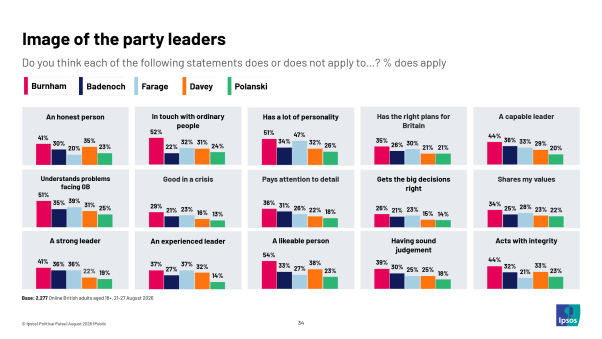
The public were then asked whether these traits did or did not apply to various party leaders. Notably, Andy Burnham leads Nigel Farage significantly on being in touch with ordinary people (52% to 32%), being honest (41% to 20%) and understanding the problems facing Britain (51% to 39%).

Image

Who do the public see as the main opposition?

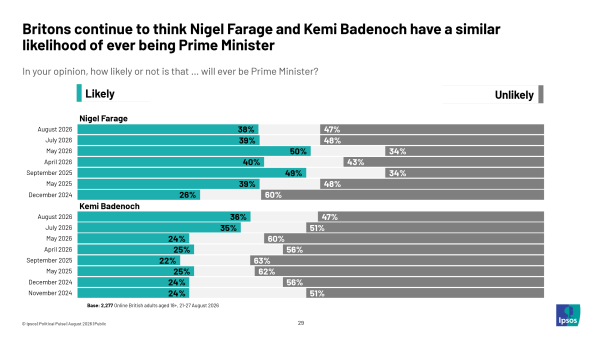
Kemi Badenoch’s position related to Nigel Farage has improved over time. She is now as likely to be seen as a future PM than Farage. This month 36% say it is likely she will be PM in the future, 47% say it is unlikely. Meanwhile, 38% say it is likely Farage will be PM and 47% say unlikely. This is in sharp contrast to last September when 63% said it was unlikely Badenoch will be PM and the public were more likely to think Nigel Farage was likely than unlikely by a 14-point margin (48% to 34%).

Image

With that said, when asked which party are the main opposition to Labour, meaning the most likely alternative government 37% still say Reform UK and 27% say the Conservatives. Although the gap has narrowed significantly from last September where Reform led by 22 points.

Benefits / drawbacks of a Reform government

When asked what the main benefits would be from a hypothetical Reform UK government the top 4 were that they would get immigration under control (33%), they represent traditional British values (22%), they represent real change for the country (20%) and they are in touch with what real people think (20%).

The main perceived negatives are ‘they would make the country more divided’ (44%), Nigel Farage would make a bad PM (40%), and they are too close with President Trump (39%).

Direction of the country

Whilst 59% think the country is heading in the wrong direction and just 17% say right direction, the proportion saying wrong direction has fallen 5 points since June and is significantly lower than the 71% recorded at the end of last year.

Commenting on the findings, Keiran Pedley, Research Director for UK politics at Ipsos, said:

As the Reform conference gets into full swing, it is clear that Andy Burnham becoming Prime Minister has changed the political landscape. He is better liked than other leading UK politicians and seen as more in touch with ordinary people than Nigel Farage. At the same time, Farage himself faces a challenge in that Kemi Badenoch’s poll ratings have improved over time and she is now seen as likely as Farage to be Prime Minister one day.

That said, it would be foolish to write off Reform UK just yet. They are still seen as the principle opposition to Labour for now and lead on the most important issue facing the country – immigration. Which all suggests they are not going away. Whether they are heading for government, on the other hand, is another matter.

  • For the full findings, please visit the Ipsos website.
  • Ipsos interviewed a representative sample of 2,277 online British adults aged 18+. Polling was conducted online between 21–27 August 2026.
  • Data are weighted to match the profile of the population. All polls are subject to a wide range of potential sources of error.


Thursday, 3 September 2026

Union advises Londoners not to use driverless taxis until DfT, TfL and platform companies come clean on status of "human safety drivers"

 From the ADCU

Are “human safety drivers” qualified and safe to support AV rollout? ADCU demands urgent answers as driverless taxis hit London streets
The App Drivers' and Couriers' Union (ADCU) is calling for urgent answers from the platform companies, the Department for Transport and Transport for London after driverless cars for hire appeared on the streets of London for the first time today.
ADCU has repeatedly raised serious concerns about the rollout of autonomous passenger vehicles, including in evidence to the London Assembly Transport Committee in June. A central unanswered question remains the status of the so-called "human safety drivers" inside the vehicles during the pilot.
ADCU is demanding immediate clarity on:
  • Who these human safety drivers are and how they have been recruited.
  • Whether they are licensed private hire drivers.
  • If they are licensed drivers, where liability sits if there is an accident or a passenger becomes unwell.
  • If they are not licensed drivers, what qualifications and authority they have to act in that role.
Cristina-Georgiana Ioanitescu, General Secretary of ADCU, said:
Londoners are being asked to trust a system without being given basic answers about who is responsible when something goes wrong. We have been asking these questions for months. If there is a collision, if a passenger becomes ill, or if a safety-critical decision has to be made, the public has a right to know exactly where liability sits and what status these so-called human safety drivers actually have."
TfL requires licensed private hire drivers to pass stringent checks before they are allowed to carry passengers, including medical, safeguarding and regulatory requirements designed to protect the public. So the obvious question is: has that same standard been applied here? If the person sitting in the vehicle is meant to intervene in a safety-critical situation, or deal with a passenger emergency, Londoners need to know whether they have gone through the same licensing and vetting process as every other private hire driver in this city. If not, why not?”
The platform companies, the Department for Transport and TfL need to answer these questions today. Until they do, we would not advise anyone to set foot in a driverless taxi.
ADCU has consistently argued that autonomous vehicle trials must not be allowed to proceed without full transparency, proper democratic oversight, and clear safeguards for passengers, workers and the wider public.

Robotaxi plans for London 'premature' say GMB warning of 'unprecedented levels of social and economic disruption' if transition plans not in place

 
Responding to reports that Uber will add driverless options for its customers in London, David McMullen, GMB Senior Organiser, said:
 

With hundreds of thousands of people employed to drive every day, we need to be really careful with the roll out of driverless cars unless we are prepared to see unprecedented levels of social and economic disruption.
 

GMB has called on TfL and the Government to urgently take responsibility for developing a plan that protects drivers and holds operators accountable for the disruption that these services will ultimately cause.
 

Until a plan is put in place to manage this transition and support drivers, it is premature to move to 'driverless' services.
 

It’s vital that we consider the implications of this before it’s too late.


Monday, 31 August 2026

Two more charged over Brent Civic Centre murder

From Metropolita Police

Police were called to reports of a stabbing at Brent Civic Centre on Engineers Way at around 14:30hrs on Tuesday, 25 August.

Officers attended alongside the London Ambulance Service and located a 17-year-old boy, David Wynter, with stab wounds. Despite the efforts of paramedics, he sadly died at the scene. His family continue to be supported by specialist officers.

On Friday, 28 August, officers arrested an 18-year-old man and a 17-year-old boy on suspicion of murder and possession of an offensive weapon.

Jahquarn St Hillaire, 18 (01.03.2008), of Preston Road, Wembley and the boy, who cannot be named for legal reasons but is from the Wembley area, were both charged on Saturday, 29 August with murder and possession of an offensive weapon.

They have been remanded to appear at Willesden Magistrates’ Court on Monday, 31 August.

A 20-year-old man was also arrested on Friday, 28 August on suspicion of assisting an offender. Diego Farquharson, 20 (24.11.2005), of Birchen Grove, NW9, has since been charged with assisting an offender and will appear at Willesden Magistrates’ Court on Monday, 31 August. He remains in police custody.

It comes after a 15-year-old boy was charged with murder on Thursday, 27 August. He was remanded in custody at Willesden Magistrates’ Court on the same date and will next appear at the Old Bailey on Thursday, 24 September.

Detective Chief Inspector Aytac Necati, who is leading the investigation, said:

“We are continuing to investigate David’s tragic death.

“I am aware that a number of individuals were in the area at the time of this incident. They may have video footage or information that could assist our investigation.

“While I would urge people not to share video footage of this incident online, we are aware that some clips may already be circulating on social media.

“I would urge anyone who sees such footage or who has information that could help officers to get in touch with us.”

Superintendent Chris Clarke, who leads emergency response policing in the area, added:

“My thoughts remain with David’s family and friends.

“We understand the concern that this incident has caused within the community.

“We have increased reassurance patrols in the local area. These will continue over the coming days and weeks.

“Residents can expect to see an increased police presence, and I would ask that anyone who has concerns speaks to officers.”

To report information to police, call 101 and quote CAD 4032/25AUG26. Alternatively, information can be provided anonymously to independent charity Crimestoppers on 0800 555 111, or via their website.


Saturday, 29 August 2026

Have your say in tree felling in Brent: current proposals - Consultation on Donaldson Road, Olive Road, Thirlmere Gardens

 There is precious little information on the Brent website but here are the links:


https://haveyoursay.brent.gov.uk/en-GB/projects/tree-felling-consultation-40-donaldson-road


https://haveyoursay.brent.gov.uk/en-GB/projects/tree-felling-consultation-36-olive-road


https://haveyoursay.brent.gov.uk/en-GB/projects/tree-felling-consultation-9-thrilmere-gardens-ha9

Survey: Brent has third most confusing recycling guidance in London


A survey by BusinessWaste.co.uk  of London boroughs has found that Brent has the third most confusing guidance on recycling.

They comment:

Scores range from 0 to 100, with a lower score indicating less confusing household recycling guidance. Flesch Reading Ease is a metric that rates text on a 0-100 scale, where higher scores mean a document is easier to read. The full dataset can be found here.

Bromley has the most confusing recycling guidance in London and in the UK, with an overall score of 71.9 out of 100. Across its website, 81 separate recycling rules and exclusions were counted. Residents use different containers for paper, plastic, glass, cans, and food, but some everyday items follow less obvious rules. Tetra Paks belong in the green box rather than the black paper box, while plastic plant pots are accepted unless they are black. Cut flowers can even go in the food waste container, provided they are wrapped in newspaper or placed in a compostable bag.

In second place is Enfield, with a score of 69.2, after 87 rules and exclusions were identified. Enfield’s blue recycling bin comes with a substantial amount of small print. For example, aluminium foil must be formed into a fist-sized ball, glass jars should be rinsed with their lids replaced, and shredded paper needs to be placed inside a paper bag. The council also warns that continued contamination, following letters to the household, could eventually result in collections being stopped and a £60 fixed penalty notice.

Brent is in third place, with a score of 66, with 79 rules and restrictions across its recycling guidance. Residents must separate paper and cardboard into a blue sack while placing other recycling in the blue-lidded bin. Some everyday items also come with detailed conditions, for example, a plastic plant pot is only accepted if it is made from PET or PP, is not black and measures more than 40mm by 40mm. Shredded paper must also be placed inside an old envelope before being recycled. 


Mark Hall, Brent waste management expert at BusinessWaste.co.uk, said:

Most recycling decisions are made in a few seconds, usually with the packaging in one hand and the bin lid already open. People are unlikely to search several council pages every time they come across an item they’re unsure how to dispose of. If an answer depends on a minor detail, such as its colour, lining or whether two parts need separating, many will either guess or throw it in their general waste bin.

Unfortunately, this creates problems for both parties as recyclable material can be lost unnecessarily, while incorrect items can contaminate waste streams. Contamination is not always a sign that residents don’t care, it can also mean the guidance didn’t clearly explain a fairly ordinary question clearly enough.

Councils should aim to keep their core household rules on one current page, use consistent names for containers and place exemptions next to the items they relate to. Clear photographs of common packaging would be a more helpful step than expecting residents to understand technical material names or plastic identification codes.


Methodology:

  1. Household recycling guidance was collected from 58 major urban areas across each nation of the UK.

  2. The areas were selected from Investment Monitor's list of the UK's largest cities as a starting point, before being expanded to all 32 London borough councils. 

    1. This was done as it would provide broad coverage of major urban areas in the UK, while also allowing each council to be assessed fairly.

  3. Researchers counted the special instructions residents were expected to follow, such as rinsing containers, removing lids or using a particular liner.

  4. Items and material categories explicitly excluded from household bins were also counted.

  5. Relevant guidance was assessed using Readable. Flesch Reading Ease was used to measure how difficult it was to read. Flesch-Kincaid grade levels were included for context but did not affect the final score.

  6. Repeated rules were counted once. Collection dates, prices, missed-collection information and other administrative guidance were excluded.

  7. Instructions, exclusions and readability were each scored from 0 to 100 and given equal weighting.

    1. Those with a higher number of rules and a higher number of exclusions were scored higher, as this was interpreted as more information for residents to interpret and understand

  8. The three component scores were averaged to produce the overall confusion score. A higher score indicates more complicated guidance.

  9. The study measures the complexity of councils’ published online guidance. It is not intended to critique the quality of their recycling services.

  10. This research is not a comprehensive review of every UK council, but rather a snapshot of councils in major UK urban areas. It purely highlights how the number of rules, exclusions and language used may affect how easily people interpret and follow the guidance provided. 

  11. Data was collected on the 13th August 2026 and is correct as of then