
Cllr Kathleen Fraser
Cllr Kathleen Fraser, a long time member of the Labour Party until her recent resignation (See LINK) will be fighting Labour as an Independent in her home watd of Barnhill.

WEMBLEY MATTERS News and views on local politics, the environment, climate change, culture and local history
Cllr Kathleen Fraser
Cllr Kathleen Fraser, a long time member of the Labour Party until her recent resignation (See LINK) will be fighting Labour as an Independent in her home watd of Barnhill.

Cllr Sunita Hirani (Independent - Kenton)
Cllr Sunita Hirani, yesterday lodged her papers with Brent Electoral Services as an Independent candidate in Kenton ward, after she was suspended from the Conservative Party.
She explained her decision to Kenton residents on Facebook:
Dear Kenton Residents,
I am writing to you directly and personally to share an important update about my political position.
My membership of the Conservative Party was recently suspended, shortly before the close of nominations on 9 April 2026. Despite my repeated requests for clarification, no clear reason has been communicated to me. Given the timing, this has been deeply upsetting and distressing, particularly in light of my continued hard work and commitment to serving our community.
After careful reflection, discussions with supporters, and most importantly putting you, my residents, first, I have decided to resign my membership of the Conservative Party and continue my work as an Independent Councillor.
This decision has not been taken lightly. I stood for election in 2022 to serve Kenton with integrity, honesty, and determination, and that commitment remains unchanged.
My priority has always been, and will continue to be, to represent the residents of Kenton Ward.
As an Independent Councillor, I will be free to:
Speak up without fear, favour, or intimidation on the issues that matter to Kenton
I remain fully committed to helping residents with local issues, whether that is housing, safety, schools, fly-tipping, parking, or navigating the council .
My door remains open, and I am here for you.
Thank you for the trust, kindness, and support so many of you have shown me
It means more than I can adequately put into words.
I hope to continue earning that trust as your Independent voice on Brent Council.
With sincere thanks,
Sunita Hirani

Guest Post
Brent Food Growers Network - First Gathering 19th April
Does your organisation grow food in Brent? Help us envision an exciting new connected growers’ network by joining us in Roundwood Park and sharing your views!
A group of us thinking about supporting food growing as part of the new Food Strategy for Brent thought it would be helpful to gather together with other Brent food growing organisations to discuss the possible formation of a Brent Food Growers Network (and anything else that might be helpful to you in your work).
Please join us, help us understand what you do, and contribute to this new conversation!
This event is for Brent food-growing organisations. We hope to hold events for the wider community at a later date.
If you would like to attend and represent your organisation (or school) please register on Eventbrite:
https://www.eventbrite.com/e/brent-food-growers-network-first-gathering-tickets-1985990229237


It shouldn't be the case in one of the largest economies in tke world that we need food banks to keep people from starving, but unfortunately that IS the case. Activism can address the causes of poverty but that is a long term effort and right now Brent Food Bank faces an immediate crisis as they have lost one of their biggest donors.
As well as donating food as above, there is now need for cash donations to save the Food Bank, situated in Church End from closure.

The Food Bank is seeking 500 'Champions' to help save it:
Our new "500 Champions" to save the food bank are being posted around Brent. This is at our partner the Ace Cafe London Ltd. If you can help us please make a donation on our Just Giving site:
https://www.justgiving.com/charity/brentfoodbank6072
We are very grateful to the the very kind people who have made a donation in the last few days. What ever size of donation you can afford, it is very gratefully received, Thank You


From Brent ACE
Representatives of most major parties will be attending a Climate and Nature Hustings organised by ACE Brent, the new coalition of environment and residents groups who campaign for a stronger council response to the climate emergency.So far the Labour Party, Green Party, Conservative Party and Liberal Democrat Party have all agreed to speak and answer residents' questions about their climate and nature plans for Brent after the elections.
The hustings will be at Barham Community Library, 660 Harrow Road, HA0 2HB on Tuesday 14th April, 7-9pm.
It will be chaired by barrister, broadcaster and local author Hashi Mohamed. It will also be online.
ACE Brent, Action on the Climate and Ecological Emergency, Brent, is a coalition of 15 environment, climate and residents groups. This includes Brent Friends of the Earth, Brent Cycling Campaign, Brent XR and Brent Parks Forum (see below for full list).
Elaine Sheppard, representing ACE Brent, says:
There is a five year window to halve emissions and prevent climate disaster. Brent council is taking climate action and has taken some steps to increase dialogue on the climate emergency. But Brent needs to do more, speak up more, and work with all of us to respond to changes already happening. Brent is benchmarked at 25 out of 33 London councils for actions taken towards net zero according to Climate Emergency UK, and 21 for Healthy Streets, according to London Boroughs Healthy Streets Scorecard. It is time to hear how parties plan to increase these scores.
All residents are encouraged to attend the hustings - to ask questions and hear about the plans of the different parties. Attendance is open to all. Please register because places are limited.
To register to attend in person, use the link bit.ly/hustper.
To register to attend online, use the link bit.ly/hustonl.
https://councilclimatescorecards.uk/
https://www.healthystreetsscorecard.london/

ACE Brent members :
Brent Cycling Campaign | Brent Friends of the Earth | Brent Parks Forum | Brent Pure Energy | Brent XR | Divest Brent | Cycletastic | Brent Healthy Streets | Friends of the Welsh Harp | One Kilburn Transport Committee | Life in Kilburn | Brent Eleven Streets Residents Association | Friends of Woodcock Park | WISE - West Indian Social Care and Education Project | CAVA - Picture Palace Harlesden
Brent Friends of the Earth is also showing the "People's Emergency Briefing" film at Preston Community Library this Thursday 9th April at 7.30pm.
This is based on the National Emergency Briefing in Westminster with appearances from Chris Packham, Deborah Meaden and others. Leading UK scientists present the latest evidence on extreme weather, Food security, Health, Cost of Living etc.
More information from info@brentfoe.com
Tickets HERE
From Brent London Renters Union

Philip Grant posted a copy of his objection to Brent Cuncil's disposal of the Northwick Park Gold open space as a comment on the recent article about the Northwick Community Garden's appeal. I asked that he allow me to share more prominently. Here it is as a Guest Blog Post. Philip writes in a personal capacity.


'Dear Brent Property and Asset Management,
Further to your Notice dated 17 March 2026 in the "Brent & Kilburn
Times", I am writing to object to the proposed disposal of open space land
known as Northwick Park Golf at 280 Watford Road.
This land was acquired jointly by Middlesex County Council and Wembley Urban
District Council (from October 1937 the Borough of Wembley) around 1936/37,
under policies designed to ensure sufficient public open space in the rapidly
expanding London suburban areas. The money borrowed from the Treasury for such
purchases in the 1930s had to be approved by the then Ministry of Health, and
one of the conditions for their consent was that the land should always remain
as public open space.
The book "Middlesex", published by Middlesex County Council in 1939
to celebrate the Council's Golden Jubilee, and written by C.W. Radcliffe, Clerk
and Solicitor to the County Council, records that the County Council's
resolution to acquire the open space at Watford Road in Wembley was approved in
1936. Such acquisitions were usually funded 75% by the County Council and 25%
by the local Council, and the book states:
'In June 1935 it was definitely decided that, in all future cases in which the
County Council agreed to make a contribution of 50 per cent or more of the cost
involved, the freehold of the land should be conveyed to the County Council. In
such cases the general practice is for the land to be leased to the borough or
district council in whose area it is situated, on a 999 years' lease at a
nominal rent. The procedure has the advantage of enabling the County Council to
exercise greater control of the open spaces than would otherwise be the case
and the County Council is in a stronger position in preventing any unauthorized
dealing with the land.'
Such 'unauthorized dealing' would include the use of the land for any purpose
other than open space available for the public to use for recreational
purposes. Under the local government reorganisation in 1965, Middlesex County
Council ceased to exist, and the freehold interest in the land, as well as the
leasehold interest held by the Borough of Wembley, passed to the new London
Borough of Brent.
But as well as the freehold passing, so did the responsibility for ensuring
that the successor to Middlesex County Council retained the freehold in that
land, to ensure that it could only be used, for the rest of the 999 years, as
open space available for public use. That is why Brent Council should not
dispose of the freehold.
New urban developments now are much denser than they were in the 1930s, so
maintaining existing open space is even more important. That is particularly so
on this site, because of the high density housing development currently taking
place next door to it in the grounds of Northwick Park Hospital. I trust that
my objection, and those of others which I am aware of, will be upheld, and that
Brent Council will not dispose of the freehold of this open space land.
Yours faithfully,
Philip Grant
Reprinted with the permission of the author and Labour Hub. Original article HERE.
This dispute is about patient safety, not just pay, argues Dr Rathi Guhadasan, writing on behalf of the Socialist Health Association.
The headlines tell one version of this story: disruption, cancelled appointments, patients stuck in the middle. It’s understandable that the government’s position resonates with many people. But headlines don’t tell the whole story.
If we’re serious about what’s good for patients in the long run, we can’t stay silent. We support the BMA’s resident doctors in their dispute with the government — and here’s why.
Fifteen Years of a Shrinking Pay Packet
This dispute didn’t start in 2025. The roots go back to 2008, when pay policy began quietly — but steadily — chipping away at what resident doctors actually earn in real terms.
Measured against the Retail Price Index — which includes housing costs and student loan interest, two of the biggest financial pressures on junior doctors — pay has fallen by roughly 22% in real value since 2008/09. Even Full Fact, the independent fact-checking organisation that questioned the BMA’s preferred measure, still agrees that pay has fallen in real terms.
Whichever way you count it, doctors’ spending power has been steadily eroded over more than a decade.
The low point came in 2022/23, when the BMA estimated the real-terms loss had reached around 29%. Strike action in 2023 forced movement. The deal struck with the newly elected Labour government in September 2024 included a combined pay uplift of 22.3% across 2023/24 and 2024/25 — though it’s worth noting that part of this had already been awarded under the previous Conservative government.
Despite those rises, resident doctors’ pay in England remained around 20.8% below where it was in 2008. The 2024 deal was progress — but it wasn’t the finish line.
Then came Labour’s offer for 2025/26: a 5.4% rise recommended by the independent pay review body. The BMA argues this still represents a real-terms pay cut when set against actual inflation. Their position is that a 26% uplift on 2024/25 basic rates is needed to fully restore pay.
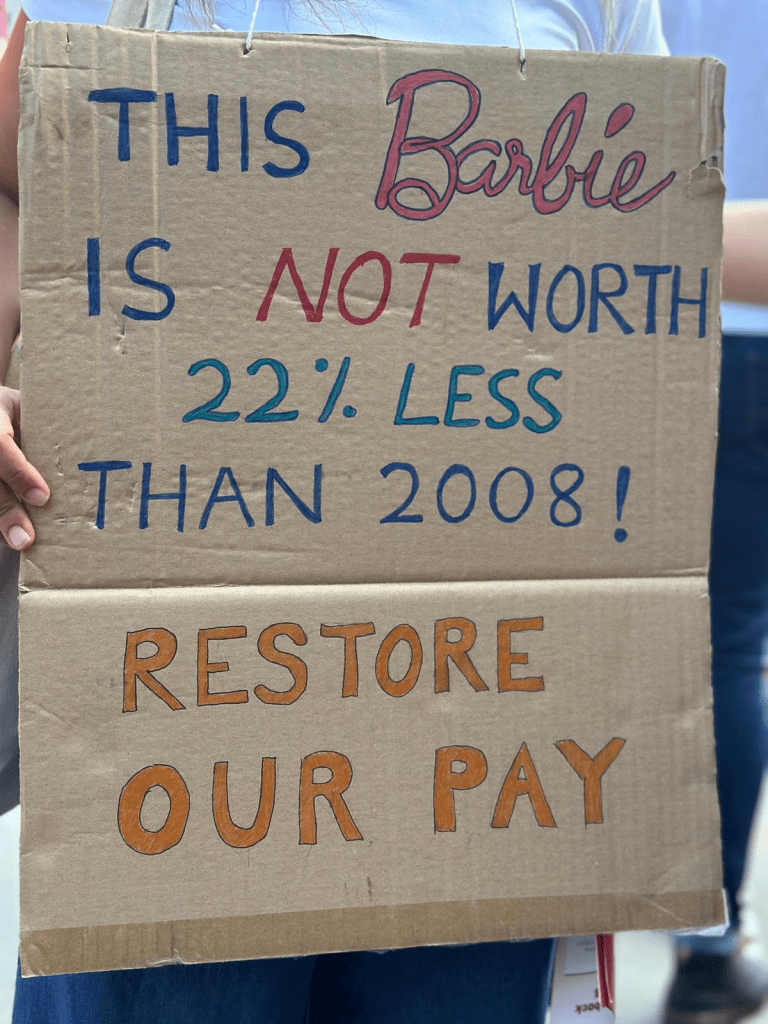
This pay gap wasn’t created by doctors. It was created by successive governments — Conservative and Labour — repeatedly choosing to let doctors’ pay fall behind the cost of living. Asking doctors to simply accept that as permanent isn’t fairness. It’s making them foot the bill for political decisions they had no part in.
The Career Bottleneck: Too Many Doctors, Too Few Opportunities
Pay is only part of what’s at stake here. There’s a second issue — one with even deeper implications for the care patients receive.
After their initial training, junior doctors must compete for specialty training posts — the pathway to becoming a consultant, a GP, or a surgeon. In 2019, there were roughly 1.4 applicants for every available training post. By 2025, that ratio had surged to more than 5 to 1. In some specialties, the figures are startling. Over 10,000 doctors applied for psychiatry training posts in 2025 — fewer than 500 places were available, amidst a national crisis in mental health care. Five doctors applied for every GP training post, at a time when millions of patients across England are struggling to get a GP appointment at all.
How did this happen? The previous Conservative government expanded medical school places without creating a matching expansion in specialty training posts. At the same time, overseas recruitment was increased — without addressing the underlying shortage of training posts. The predictable result: thousands of doctors unable to move forward in their careers, or unable to find posts at all.
This isn’t just a career problem for individual doctors. It has direct consequences for patients. The Lancet has warned that the consultant bottleneck alone could leave up to 11,000 posts unfilled by 2048. The NHS is training doctors it cannot then absorb into the senior roles they were trained for — while using less-qualified staff to plug the gaps those doctors could fill, if only the training posts existed.
The government’s response was to pass the Medical Training (Prioritisation) Act in early 2026, giving UK medics priority in competing for these posts. But overseas-trained doctors have been a vital lifeline for the NHS, filling critical gaps that the domestic system failed to plug. The answer is not fewer doctors but a dramatic expansion of the training posts needed to develop the service we need, one that is fully resourced and fit for the 21st century.
And legislation about who gets to compete for too few positions doesn’t solve the problem – for doctors or patients. As one surgeon put it in parliamentary debate: “If we increase the number of trainees, we will also need to increase the number of consultants and GPs. If we do not do that, we will simply push the bottleneck down the road.”
The Substitution Problem: Who Is Actually Treating You?
Here’s the part of this crisis that gets the least attention — but as patients, should scare us most of all.
Across the NHS, physician associates (PAs) and anaesthesia associates (AAs) are increasingly being used to fill roles that have traditionally been carried out by doctors.
PAs typically hold a two-year postgraduate qualification. They cannot prescribe medication independently and they cannot make admission or discharge decisions on their own. They are not doctors. Yet in too many NHS trusts, they have been placed in clinical roles that require a doctor’s training, a doctor’s legal accountability, and a doctor’s level of skill — at a lower cost to the employer. The previous government planned for 10,000 PAs in the NHS by 2036/37 and Labour so far has stuck to this plan.
This isn’t a fringe concern. A BMA survey of more than 18,000 doctors found that 87% believed the way PAs currently work poses a risk to patient safety. The case of Emily Chesterton — a 30-year-old woman who died after being misdiagnosed by a PA she believed to be her GP — brought these concerns into sharp public focus.
In response, the Royal College of General Practitioners withdrew its support for PAs in primary care in September 2024. The government commissioned an independent review (the Leng Review), which reported in July 2025, and the GMC began formally regulating PAs and AAs from December 2024. The Socialist Health Association argued two years ago for an immediate recruitment freeze and eventual phase-out of existing roles.
But none of that changes the basic financial logic driving the problem: PAs cost less. In an NHS under constant financial pressure, the incentive to fill a rota gap with a PA rather than a fully trained doctor doesn’t go away just because a policy document says it should. It won’t change until the underlying structural conditions change.
This Is a Patient Safety Issue, Not Just a Pay Row
All of this connects. A doctor who is financially worse off year on year, who can’t see a clear path to the specialty they trained for, who watches less-qualified staff fill roles that should support their own development, and who routinely works hours that exceed safe limits — that doctor is not at their best. And that matters for the patients they treat.
Burnout, moral injury and emigration are not abstract risks. The NHS is already losing trained doctors to Australia, Canada and New Zealand in significant numbers — partly because those systems offer better pay, clearer career prospects, and a greater sense of professional respect.
When we allow the conditions driving that exodus to persist — when we systematically underpay, under-employ, and structurally sideline the doctors we’ve spent public money training — we’re not saving money. We’re deferring the cost onto future patients, future NHS budgets, and future governments left with a consultant workforce too small to meet the needs of an ageing population.
Where Things Stand
The BMA’s resident doctors committee rejected the government’s most recent offer at the end of March 2026. The government says it was a generous deal — pay rises over three years, up to 4,500 additional specialty training posts, and reimbursement of Royal College exam fees. The BMA says the pay trajectory still embeds a real-terms cut, and that 4,500 posts over three years falls far short of addressing a deficit measured in tens of thousands.
A settlement that doesn’t genuinely reverse fifteen years of real-terms pay erosion — and that doesn’t commit meaningfully to expanding specialty training at a scale that matches the problem — isn’t a solution. It’s another chapter in managed decline, dressed up as responsible government.
An Honest Reckoning
Strike action causes real disruption. Patients have appointments cancelled. Procedures are delayed. Those are genuine harms, and they fall on people who are already unwell.
But let’s apply the same honesty to what happens if this dispute isn’t resolved. What is the cost of letting a generation of medical graduates be lost to other countries or to career stagnation? What is the cost of systematically replacing clinical expertise with associate roles that don’t carry equivalent training or legal responsibility? What is the cost of a consultant workforce that, by the 2040s, is too thin to serve an ageing population?
The disruption of a strike is visible and immediate. The harm of getting this wrong is invisible and slow — until it isn’t. When the Prime Minister and the Health Secretary threaten to withdraw training places, it is the patients of the future who are most at risk.
Our Position
We want this dispute resolved — with an agreement that honestly reflects what has happened to medical pay and medical careers over the past fifteen years. That agreement must include a credible commitment to expanding specialty training at a scale that actually matches the pipeline of doctors the NHS has already trained.
Until that agreement exists, we stand with the doctors who are asking for it.
Dr Rathi Guhadasan is Chair of the Socialist Health Association.

