Showing posts with label BMA. Show all posts

Friday, 3 April 2026

Socialist Health Association: Why We Stand With Resident Doctors

 Reprinted with the permission of the author and Labour Hub. Original article HERE.


This dispute is about patient safety, not just pay, argues Dr Rathi Guhadasan, writing on behalf of the Socialist Health Association.

The headlines tell one version of this story: disruption, cancelled appointments, patients stuck in the middle. It’s understandable that the government’s position resonates with many people. But headlines don’t tell the whole story.

If we’re serious about what’s good for patients in the long run, we can’t stay silent. We support the BMA’s resident doctors in their dispute with the government — and here’s why.

Fifteen Years of a Shrinking Pay Packet

This dispute didn’t start in 2025. The roots go back to 2008, when pay policy began quietly — but steadily — chipping away at what resident doctors actually earn in real terms.

Measured against the Retail Price Index — which includes housing costs and student loan interest, two of the biggest financial pressures on junior doctors — pay has fallen by roughly 22% in real value since 2008/09. Even Full Fact, the independent fact-checking organisation that questioned the BMA’s preferred measure, still agrees that pay has fallen in real terms. 

Whichever way you count it, doctors’ spending power has been steadily eroded over more than a decade.

The low point came in 2022/23, when the BMA estimated the real-terms loss had reached around 29%. Strike action in 2023 forced movement. The deal struck with the newly elected Labour government in September 2024 included a combined pay uplift of 22.3% across 2023/24 and 2024/25 — though it’s worth noting that part of this had already been awarded under the previous Conservative government.

Despite those rises, resident doctors’ pay in England remained around 20.8% below where it was in 2008. The 2024 deal was progress — but it wasn’t the finish line.

Then came Labour’s offer for 2025/26: a 5.4% rise recommended by the independent pay review body. The BMA argues this still represents a real-terms pay cut when set against actual inflation. Their position is that a 26% uplift on 2024/25 basic rates is needed to fully restore pay.
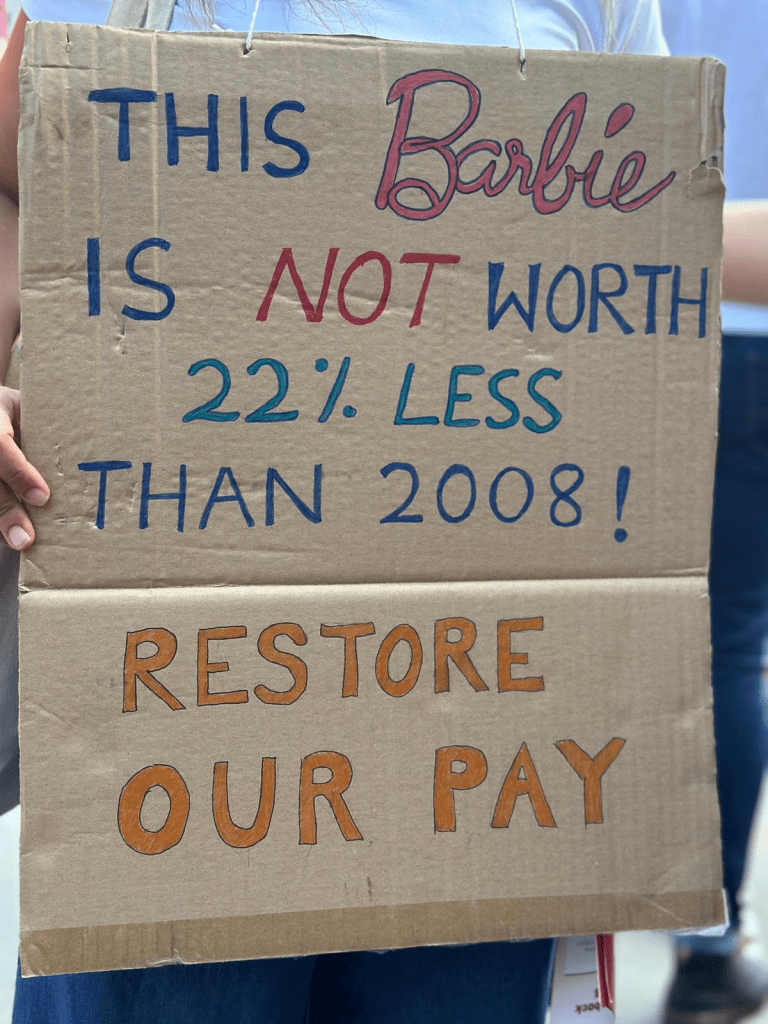
 

This pay gap wasn’t created by doctors. It was created by successive governments — Conservative and Labour — repeatedly choosing to let doctors’ pay fall behind the cost of living. Asking doctors to simply accept that as permanent isn’t fairness. It’s making them foot the bill for political decisions they had no part in.

The Career Bottleneck: Too Many Doctors, Too Few Opportunities

Pay is only part of what’s at stake here. There’s a second issue — one with even deeper implications for the care patients receive.

After their initial training, junior doctors must compete for specialty training posts — the pathway to becoming a consultant, a GP, or a surgeon. In 2019, there were roughly 1.4 applicants for every available training post. By 2025, that ratio had surged to more than 5 to 1. In some specialties, the figures are startling. Over 10,000 doctors applied for psychiatry training posts in 2025 — fewer than 500 places were available, amidst a national crisis in mental health care. Five doctors applied for every GP training post, at a time when millions of patients across England are struggling to get a GP appointment at all.

How did this happen? The previous Conservative government expanded medical school places without creating a matching expansion in specialty training posts. At the same time, overseas recruitment was increased — without addressing the underlying shortage of training posts. The predictable result: thousands of doctors unable to move forward in their careers, or unable to find posts at all.

This isn’t just a career problem for individual doctors. It has direct consequences for patients. The Lancet has warned that the consultant bottleneck alone could leave up to 11,000 posts unfilled by 2048. The NHS is training doctors it cannot then absorb into the senior roles they were trained for — while using less-qualified staff to plug the gaps those doctors could fill, if only the training posts existed.

The government’s response was to pass the Medical Training (Prioritisation) Act in early 2026, giving UK medics priority in competing for these posts. But overseas-trained doctors have been a vital lifeline for the NHS, filling critical gaps that the domestic system failed to plug. The answer is not fewer doctors but a dramatic expansion of the training posts needed to develop the service we need, one that is fully resourced and fit for the 21st century.

And legislation about who gets to compete for too few positions doesn’t solve the problem – for doctors or patients. As one surgeon put it in parliamentary debate: “If we increase the number of trainees, we will also need to increase the number of consultants and GPs. If we do not do that, we will simply push the bottleneck down the road.”

The Substitution Problem: Who Is Actually Treating You?

Here’s the part of this crisis that gets the least attention — but as patients, should scare us most of all.

Across the NHS, physician associates (PAs) and anaesthesia associates (AAs) are increasingly being used to fill roles that have traditionally been carried out by doctors.

PAs typically hold a two-year postgraduate qualification. They cannot prescribe medication independently and they cannot make admission or discharge decisions on their own. They are not doctors. Yet in too many NHS trusts, they have been placed in clinical roles that require a doctor’s training, a doctor’s legal accountability, and a doctor’s level of skill — at a lower cost to the employer. The previous government planned for 10,000 PAs in the NHS by 2036/37 and Labour so far has stuck to this plan.

This isn’t a fringe concern. A BMA survey of more than 18,000 doctors found that 87% believed the way PAs currently work poses a risk to patient safety. The case of Emily Chesterton — a 30-year-old woman who died after being misdiagnosed by a PA she believed to be her GP — brought these concerns into sharp public focus.

In response, the Royal College of General Practitioners withdrew its support for PAs in primary care in September 2024. The government commissioned an independent review (the Leng Review), which reported in July 2025, and the GMC began formally regulating PAs and AAs from December 2024. The Socialist Health Association argued two years ago for an immediate recruitment freeze and eventual phase-out of existing roles.

But none of that changes the basic financial logic driving the problem: PAs cost less. In an NHS under constant financial pressure, the incentive to fill a rota gap with a PA rather than a fully trained doctor doesn’t go away just because a policy document says it should. It won’t change until the underlying structural conditions change.

This Is a Patient Safety Issue, Not Just a Pay Row

All of this connects. A doctor who is financially worse off year on year, who can’t see a clear path to the specialty they trained for, who watches less-qualified staff fill roles that should support their own development, and who routinely works hours that exceed safe limits — that doctor is not at their best. And that matters for the patients they treat.

Burnout, moral injury and emigration are not abstract risks. The NHS is already losing trained doctors to Australia, Canada and New Zealand in significant numbers — partly because those systems offer better pay, clearer career prospects, and a greater sense of professional respect.

When we allow the conditions driving that exodus to persist — when we systematically underpay, under-employ, and structurally sideline the doctors we’ve spent public money training — we’re not saving money. We’re deferring the cost onto future patients, future NHS budgets, and future governments left with a consultant workforce too small to meet the needs of an ageing population.

Where Things Stand

The BMA’s resident doctors committee rejected the government’s most recent offer at the end of March 2026. The government says it was a generous deal — pay rises over three years, up to 4,500 additional specialty training posts, and reimbursement of Royal College exam fees. The BMA says the pay trajectory still embeds a real-terms cut, and that 4,500 posts over three years falls far short of addressing a deficit measured in tens of thousands.

A settlement that doesn’t genuinely reverse fifteen years of real-terms pay erosion — and that doesn’t commit meaningfully to expanding specialty training at a scale that matches the problem — isn’t a solution. It’s another chapter in managed decline, dressed up as responsible government.

An Honest Reckoning

Strike action causes real disruption. Patients have appointments cancelled. Procedures are delayed. Those are genuine harms, and they fall on people who are already unwell.

But let’s apply the same honesty to what happens if this dispute isn’t resolved. What is the cost of letting a generation of medical graduates be lost to other countries or to career stagnation? What is the cost of systematically replacing clinical expertise with associate roles that don’t carry equivalent training or legal responsibility? What is the cost of a consultant workforce that, by the 2040s, is too thin to serve an ageing population?

The disruption of a strike is visible and immediate. The harm of getting this wrong is invisible and slow — until it isn’t. When the Prime Minister and the Health Secretary threaten to withdraw training places, it is the patients of the future who are most at risk.

Our Position

We want this dispute resolved — with an agreement that honestly reflects what has happened to medical pay and medical careers over the past fifteen years. That agreement must include a credible commitment to expanding specialty training at a scale that actually matches the pipeline of doctors the NHS has already trained.

Until that agreement exists, we stand with the doctors who are asking for it.

Dr Rathi Guhadasan is Chair of the Socialist Health Association.

Wednesday, 15 March 2023

Creativity and solidarity come together in today's Great Strike March in London


 Despite the tube strike striking workers from across the country including teachers, junior doctors, civil servants, university lecturers and tube workers came together today for a high spirited and creative march and rally in London.

The video above gives just a taste of  magnificent day.

Here is a parade of the placards that were on display.


Thursday, 1 September 2016

Green MEP backs Junior Hospital Doctors & calls Hunt 'incompetent'

Keith Taylor, Green MEP for the South East of England, has accused Jeremy Hunt of 'incompetence' and pledged to 'stand in solidarity' with Junior Doctors following the BMA's latest notice of industrial action.

Keith, a vocal supporter of the NHS Reinstatement Bill who sits on the European Parliament's Public Health committee, said:
It seemed inevitable that our Junior Doctors would announce further industrial action and it’s deeply saddening that they have been forced to this point by the intransigence of an incompetent Health Secretary.

That the BMA announcement comes just days after the government was forced to reveal its plans to shut down NHS services across England is a stark reminder of the perilous condition of our National Health Service after years of Tory mismanagement.

With a demoralised, woefully under-resourced workforce, a ‘7-day plan’ exposed as a cynical ploy to open up services to further privatisation, and a Health Secretary apparently charged with undermining one of our proudest public services; it is clearer than ever that this government cannot be trusted with the NHS.

A government that believed in a truly public NHS would put forward a contract that is fair and safe for staff and patients alike. A conscientious Health Secretary would cease his relentless attempts to smear a strained workforce tirelessly plugging huge rota gaps with good will alone.

Until that happens, I and other NHS champions will continue to join the overwhelming majority of the British public in offering solidarity to the frontline NHS staff fighting to protect our beloved health service. Industrial action remains the last resort for desperate junior doctors. The BMA has already made countless offers to re-open negotiations with Jeremy Hunt.

Sunday, 10 January 2016

Junior doctors accuse Hunt of gambling with lives: 'Jeremy's Punt' stunt


A faux betting shop storefront has been erected outside a London hospital and the Palace of Westminster by the junior doctors campaign group, ahead of the first planned strike on Tuesday January 12, to represent how Health Secretary Jeremy Hunt’s plans to introduce radical reforms to doctors’ contracts could gamble with the public’s health.

The betting shop, dubbed “Jeremy’s Punt” was launched as the Government's continued failure to address doctors' concerns that no proper safeguards have been put in place to prevent hospitals from forcing them to work dangerously long hours.

Junior doctors are worried that the new contract will lead to increasingly unsafe working patterns without adequate rest and recovery, as well as changes to the definition of ‘office hours’ weekday and weekend working.

The fake betting shop was offering ‘Money Back’ if Hunt re-negotiates, ‘Evens on being treated by an overworked doctor’ and ‘3/1 on reforms causing a preventable medical error’ as a way to get the message across.

The monitoring system that protects the number of hours junior doctors can work has been in place for over 15 years, but now, under the proposed reforms, faces a drastic alteration that could put the public’s lives in danger, doctors say.

Following a freedom of information request, doctors have received confirmation from the Department Of Health that there has been no specific assessment into modeling patient safety under the new contract, showing that Hunt’s actions are a gamble.

Doctors’ fears carry merit as the most recent study into fatigue and medical errors, published in the Journal of the American Medical Association in September 2009*, revealed that fatigue could see an increase of medical error rise by 15%. 

Dr Nadia Masood, an anaesthetic trainee in London said:
We work hard to keep our patients safe and want to continue doing so.  You wouldn’t drive for 13 hours without proper breaks, yet the government want to remove vital safeguards in their version of the new contract. Tired doctors make mistakes, this contract doesn’t protect patients or staff adequately.
We chose this profession because of an innate passion for the care of people, but these reforms are showing a lack of that for both the public and us. We cannot gamble with people’s lives, plain and simple.
Initially the government was content to remove the safeguards entirely, but under pressure from the BMA (British Medical Association), created the role of ‘guardian’ to protect junior doctors from working unsafe hours. However, the Government is insisting that hospital trusts make this appointment, without input from the BMA, leading to a conflict of interest where junior doctors believe the guardian’s true agenda will be helping the overstretched hospital trusts to cut costs, not ending unsafe practice.

The proposed contract will also mean that doctors working shifts as late as 1.59am, which are not classified as night shifts, will not receive the necessary protections (breaks and rest periods) before being back on duty.

Dr Marie-Estella McVeigh, a junior doctor in London said:
For all of us, the strikes, planned to start on Tuesday, are the last resort to make Jeremy Hunt listen to the issues that we face on the front line of patient care. This is not about getting more money; the Government and BMA have agreed right from the start that the total cost of changes remains neutral, there’s no increase in the pay bill.
As doctors we are deeply concerned about safety. We feel the Government are not listening to our concerns and are playing games by ignoring 50,000 junior doctor whistle-blowers.
The current dispute centres on the Government’s new contract offer, which focuses on changes in working hours, patterns and conditions as well as restructuring and distributing pay within a neutral pay package.

Saturday, 28 November 2015

How to support the Junior Doctors' action


STATEMENT ON JUNIOR DOCTORS' STRIKE

TO OUR FELLOW NHS WORKERS, TRADE UNIONISTS AND CAMPAIGNERS

On Tuesday 1st December it is likely that Junior Doctors across the UK will commence industrial action against the Governments continued threat of imposition of an unsafe new Contract.

This industrial action is the last resort for junior doctors in an attempt to prevent the Imposition of a contract that we feel would jeopardize the profession, patient care and the NHS for a generation.

This is not a decision that has been taken lightly and Doctors have united in the hope that this action will protect the NHS for future generations.

Our ballot result of 98% for strike action means that Junior doctors in England have given the BMA a huge mandate to proceed.

Over the last few weeks I have met many of you as individuals or as members of your organisations and on occasion have had the opportunity to speak alongside you at events. As one of the co-ordinators for the imminent strike action in north London the last few days have been incredibly busy and are getting busier still.

I apologise profusely if I have not had the chance to return some of your calls or email in time. It is highly unlikely that I will be able to respond in the next few days either. We still have a logistical mountain to climb!

I am also aware that many of you have had some fruitful contact with other BMA junior doctor’s representatives and activists. This is excellent.

On behalf of the entire BMA we thank you all for your solidarity.

I write to inform you of a few details with regards to the planned action and to invite you to come out and display your support for us on the days of action.

The action will begin with an emergency care-only model, which would see junior doctors provide the same level of service that happens in their given specialty, hospital or GP practice on Christmas Day. It will then escalate to full walk-outs. The action as proposed is:

Emergency care only — from 8am, Tuesday 1 December to 8am Wednesday 2 December
Full withdrawal of junior doctors' labour — from 8am to 5pm, Tuesday 8 December
Full withdrawal of junior doctors' labour — from 8am to 5pm, Wednesday 16 December.

The aim is to picket all major hospitals in England on all three days of proposed action. This means that most major district general hospitals will be included. Pickets will be in the vicinity of the main entrances and will start at 8am, continuing until at least 12.30pm. However, many picket sites will continue into the evening, especially at the larger hospitals.

Please see below for a list of the major hospitals in London. I include the nearest Tube stop to each. Along with the pickets there will be parallel “Meet The Doctors” events at these tube stations as well as nearby public spaces. We will direct you to these public spaces from the picket.

You may have read recently of the ACAS conciliation process which has begun. Our key requirement for a return to negotiation is that Hunt must abandon “imposition”.

Please turn up on the days of action, and give us your support. We will then inform you if other local events are planned on the day. If you are an allied health worker, trade unionist, or campaigner please do consider bringing along the banner representing your organisation, your working uniform or similar. We would appreciate it however if banners in explicit endorsement of specific political parties are not displayed and that any selling of campaign literature such as newspapers is discreet.
On the days of action, please do debate us, educate us and invite us to address your colleagues in your workplace or trade union branch.

In London, Junior doctors will be striking at the following hospitals (as well as at other smaller hospitals within the capital). I list only the London hospitals as this is the geographical area of my involvement. As mentioned at the start of this email. Almost any hospital of any size in England will have a picket and a local event taking place.

St Bartholomew’s Hospital (St Pauls tube)
The Royal London Hospital (Whitechapel tube)
Homerton University Hospital (Homerton Overground)
Whipps Cross University Hospital (Walthamstow Central and Leytonstone
Newham University Hospital
Queen’s Hospital (Romford rail station)
King George (Ilford tube)
Great Ormond Street, (Russel Sq Tube and Holborn Tube)
St Marys, (Paddington Tube)
Northwick Park, (Northwick Park Met line)
North Middlesex (Silver St station)
Barnet, (High Barnet tube)
Royal Free, (Belsize Park tube, Hampstead Heath Overground)
UCH, (Euston Station/tube, Euston Square tube, Warren St tube)
Whittington (Archway tube)
St Georges (Tooting)
St Thomas' (Waterloo)
Guys (London Bridge)
Kings College Hospital (Denmark Hill)
kind regards and Solidarity,

Dr Yannis Gourtsoyannis, BMA Junior Doctors Committee