
Reprinted with the permission of the author and Labour Hub. Original article HERE.
This dispute is about patient safety, not just pay, argues Dr Rathi Guhadasan, writing on behalf of the Socialist Health Association.
The headlines tell one version of this story: disruption, cancelled appointments, patients stuck in the middle. It’s understandable that the government’s position resonates with many people. But headlines don’t tell the whole story.
If we’re serious about what’s good for patients in the long run, we can’t stay silent. We support the BMA’s resident doctors in their dispute with the government — and here’s why.
Fifteen Years of a Shrinking Pay Packet
This dispute didn’t start in 2025. The roots go back to 2008, when pay policy began quietly — but steadily — chipping away at what resident doctors actually earn in real terms.
Measured against the Retail Price Index — which includes housing costs and student loan interest, two of the biggest financial pressures on junior doctors — pay has fallen by roughly 22% in real value since 2008/09. Even Full Fact, the independent fact-checking organisation that questioned the BMA’s preferred measure, still agrees that pay has fallen in real terms.
Whichever way you count it, doctors’ spending power has been steadily eroded over more than a decade.
The low point came in 2022/23, when the BMA estimated the real-terms loss had reached around 29%. Strike action in 2023 forced movement. The deal struck with the newly elected Labour government in September 2024 included a combined pay uplift of 22.3% across 2023/24 and 2024/25 — though it’s worth noting that part of this had already been awarded under the previous Conservative government.
Despite those rises, resident doctors’ pay in England remained around 20.8% below where it was in 2008. The 2024 deal was progress — but it wasn’t the finish line.
Then came Labour’s offer for 2025/26: a 5.4% rise recommended by the independent pay review body. The BMA argues this still represents a real-terms pay cut when set against actual inflation. Their position is that a 26% uplift on 2024/25 basic rates is needed to fully restore pay.
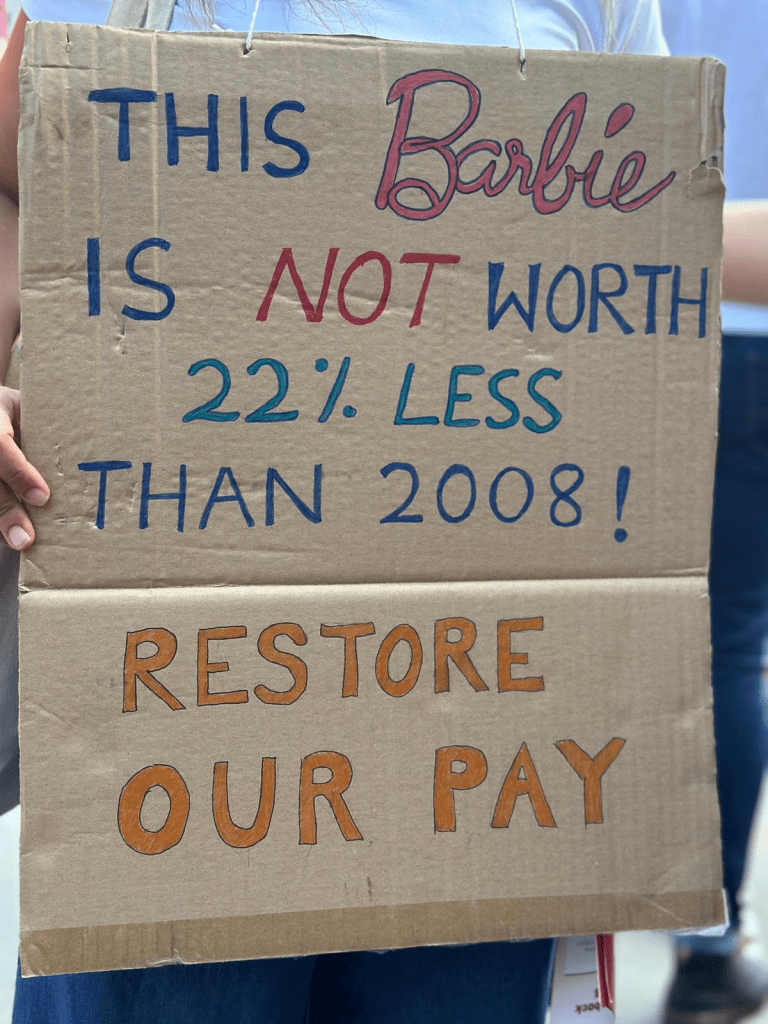
This pay gap wasn’t created by doctors. It was created by successive governments — Conservative and Labour — repeatedly choosing to let doctors’ pay fall behind the cost of living. Asking doctors to simply accept that as permanent isn’t fairness. It’s making them foot the bill for political decisions they had no part in.
The Career Bottleneck: Too Many Doctors, Too Few Opportunities
Pay is only part of what’s at stake here. There’s a second issue — one with even deeper implications for the care patients receive.
After their initial training, junior doctors must compete for specialty training posts — the pathway to becoming a consultant, a GP, or a surgeon. In 2019, there were roughly 1.4 applicants for every available training post. By 2025, that ratio had surged to more than 5 to 1. In some specialties, the figures are startling. Over 10,000 doctors applied for psychiatry training posts in 2025 — fewer than 500 places were available, amidst a national crisis in mental health care. Five doctors applied for every GP training post, at a time when millions of patients across England are struggling to get a GP appointment at all.
How did this happen? The previous Conservative government expanded medical school places without creating a matching expansion in specialty training posts. At the same time, overseas recruitment was increased — without addressing the underlying shortage of training posts. The predictable result: thousands of doctors unable to move forward in their careers, or unable to find posts at all.
This isn’t just a career problem for individual doctors. It has direct consequences for patients. The Lancet has warned that the consultant bottleneck alone could leave up to 11,000 posts unfilled by 2048. The NHS is training doctors it cannot then absorb into the senior roles they were trained for — while using less-qualified staff to plug the gaps those doctors could fill, if only the training posts existed.
The government’s response was to pass the Medical Training (Prioritisation) Act in early 2026, giving UK medics priority in competing for these posts. But overseas-trained doctors have been a vital lifeline for the NHS, filling critical gaps that the domestic system failed to plug. The answer is not fewer doctors but a dramatic expansion of the training posts needed to develop the service we need, one that is fully resourced and fit for the 21st century.
And legislation about who gets to compete for too few positions doesn’t solve the problem – for doctors or patients. As one surgeon put it in parliamentary debate: “If we increase the number of trainees, we will also need to increase the number of consultants and GPs. If we do not do that, we will simply push the bottleneck down the road.”
The Substitution Problem: Who Is Actually Treating You?
Here’s the part of this crisis that gets the least attention — but as patients, should scare us most of all.
Across the NHS, physician associates (PAs) and anaesthesia associates (AAs) are increasingly being used to fill roles that have traditionally been carried out by doctors.
PAs typically hold a two-year postgraduate qualification. They cannot prescribe medication independently and they cannot make admission or discharge decisions on their own. They are not doctors. Yet in too many NHS trusts, they have been placed in clinical roles that require a doctor’s training, a doctor’s legal accountability, and a doctor’s level of skill — at a lower cost to the employer. The previous government planned for 10,000 PAs in the NHS by 2036/37 and Labour so far has stuck to this plan.
This isn’t a fringe concern. A BMA survey of more than 18,000 doctors found that 87% believed the way PAs currently work poses a risk to patient safety. The case of Emily Chesterton — a 30-year-old woman who died after being misdiagnosed by a PA she believed to be her GP — brought these concerns into sharp public focus.
In response, the Royal College of General Practitioners withdrew its support for PAs in primary care in September 2024. The government commissioned an independent review (the Leng Review), which reported in July 2025, and the GMC began formally regulating PAs and AAs from December 2024. The Socialist Health Association argued two years ago for an immediate recruitment freeze and eventual phase-out of existing roles.
But none of that changes the basic financial logic driving the problem: PAs cost less. In an NHS under constant financial pressure, the incentive to fill a rota gap with a PA rather than a fully trained doctor doesn’t go away just because a policy document says it should. It won’t change until the underlying structural conditions change.
This Is a Patient Safety Issue, Not Just a Pay Row
All of this connects. A doctor who is financially worse off year on year, who can’t see a clear path to the specialty they trained for, who watches less-qualified staff fill roles that should support their own development, and who routinely works hours that exceed safe limits — that doctor is not at their best. And that matters for the patients they treat.
Burnout, moral injury and emigration are not abstract risks. The NHS is already losing trained doctors to Australia, Canada and New Zealand in significant numbers — partly because those systems offer better pay, clearer career prospects, and a greater sense of professional respect.
When we allow the conditions driving that exodus to persist — when we systematically underpay, under-employ, and structurally sideline the doctors we’ve spent public money training — we’re not saving money. We’re deferring the cost onto future patients, future NHS budgets, and future governments left with a consultant workforce too small to meet the needs of an ageing population.
Where Things Stand
The BMA’s resident doctors committee rejected the government’s most recent offer at the end of March 2026. The government says it was a generous deal — pay rises over three years, up to 4,500 additional specialty training posts, and reimbursement of Royal College exam fees. The BMA says the pay trajectory still embeds a real-terms cut, and that 4,500 posts over three years falls far short of addressing a deficit measured in tens of thousands.
A settlement that doesn’t genuinely reverse fifteen years of real-terms pay erosion — and that doesn’t commit meaningfully to expanding specialty training at a scale that matches the problem — isn’t a solution. It’s another chapter in managed decline, dressed up as responsible government.
An Honest Reckoning
Strike action causes real disruption. Patients have appointments cancelled. Procedures are delayed. Those are genuine harms, and they fall on people who are already unwell.
But let’s apply the same honesty to what happens if this dispute isn’t resolved. What is the cost of letting a generation of medical graduates be lost to other countries or to career stagnation? What is the cost of systematically replacing clinical expertise with associate roles that don’t carry equivalent training or legal responsibility? What is the cost of a consultant workforce that, by the 2040s, is too thin to serve an ageing population?
The disruption of a strike is visible and immediate. The harm of getting this wrong is invisible and slow — until it isn’t. When the Prime Minister and the Health Secretary threaten to withdraw training places, it is the patients of the future who are most at risk.
Our Position
We want this dispute resolved — with an agreement that honestly reflects what has happened to medical pay and medical careers over the past fifteen years. That agreement must include a credible commitment to expanding specialty training at a scale that actually matches the pipeline of doctors the NHS has already trained.
Until that agreement exists, we stand with the doctors who are asking for it.
Dr Rathi Guhadasan is Chair of the Socialist Health Association.

2 comments:
👎 this form of fake socialist output makes me really angry. Junior doctors are not some uniquely hard done by profession. It’s heavily middle and upper class, full of family dynasties, people whose parents were doctors or had the right connections.
So when people talk about being underpaid you have to keep that in perspective. If things were genuinely that bad, more of them would leave. They’re highly educated, capable people right? they could go into other sectors without much trouble. But most don’t, and that’s because medicine still offers a pretty strong deal overall, good lifetime earnings, stability, and social status that most workers don’t have access to. Especially as the entry level salary, straight out of university that is being used as the headline, is just for one year and extras.
The bit that really doesn’t sit right is the attempt to frame this as some kind of socialist position while also going after physician associates. YOU CANNNOT CLAIM CLASS SOLIDARITY then spend a chunk of your argument attacking a lower status role that, in reality, is a more accessible way into healthcare for people outside the traditional medical track. This is where the people locked out of medical practice by the dynasties go.
There’s also an exaggeration around what only doctors can safely do. Of course specialist training matters and no one is arguing otherwise, but not every task requires someone with a decade of medical training. Expanding roles like PAs and advanced nurses can be a practical response to staffing pressures if they’re properly regulated, rather than this idea that it’s inherently unsafe. I love nurse prescribing for example, how much easier are our lives calling the surgery now?
At the same time, the people who are actually feeling the squeeze the most are barely centred in this argument. Staff on Agenda for Change contracts, nurses, healthcare assistants, allied health professionals, they’ve seen years of pay erosion on much lower wages and are doing constant frontline care. If the argument is really about fairness, it’s hard to see why they aren’t the priority. Yet you never see junior drs speaking about these nhs colleagues do you? It is always gimmie gimmie gimmie.
There’s a wider structural issue as well. Medicine is still pretty closed off to large parts of the working class so if some of the current intake, who skew more privileged, decide to leave or choose other careers, that doesn’t automatically spell disaster. It could create space to widen access in a way that hasn’t really happened so far. This would be a positive as it is from the working class that innovation comes.
So id like to remind the readers here this isn’t just a simple case of underpaid workers versus the government. There’s also an element of a high status profession trying to maintain its position, while directing frustration at groups with less power within the system like the PAs (really made me sick reading that 🤢 )
The NHS has morphed into 'the health service' social select and postcode, strategic planned not a 'lottery'. Politicians for inequalities growth.
Post a Comment