From Brent Council
|

WEMBLEY MATTERS News and views on local politics, the environment, climate change, culture and local history
From Brent Council
|

The problem of overflowing bins...

Brent Council officers have supplied Cllr Suzanne Gallagher (Green Party Kilburn Councillor) with further information on how the extra resources in the 12 month variation of the Veolia contract will be deployed:
Distribution of Resources
Could officers please advise:
1. How the additional litter pickers will be allocated across the borough.
The deployment of the additional litter pickers will be flexible to account for emerging pressures on a day to day basis. Each Brent Connects area will receive 1x extra dedicated litter picker.
2. How many of the additional litter-picking resources are expected to be deployed within Kilburn Ward.
As above. There will be 1 litter picker for your Brent Connects are, and any deployment specifically within Kilburn ward will be determined on a day to day basis depending on need and other priorities.
3. Whether there is a ward-by-ward or area-by-area breakdown of the anticipated allocation of resources.
The additional litter picking resource is being applied on a Brent Connects area basis. The mechanical sweeping and the two additional fly-tip clearance teams are being deployed on a north of Brent and south of Brent basis.
4. What criteria have been used to determine where the additional resources will be deployed.
Neighbourhood Mangers will determine the day to day deployment through discussion with their counterparts at Veolia. The decision-making will reflect monitoring outcomes and FMS data.
5. Whether historic complaint data, Fix My Street reports, fly-tipping reports or cleanliness indicators were used in determining allocations.
Yes, this will be helpful in determining day to day deployment.
Housing Estates Trial
The decision refers to a trial of an additional vehicle and two-person crew for Brent Housing Estates. Could officers please advise:
6. Which estates will be included within the trial.
A select range of the most challenging estate locations across Brent.
7. Whether any estates within Kilburn Ward or the wider South Kilburn area will benefit from the additional resource.
Blocks at Stafford Road, Malvern Road, Cambridge Road,
William Dunbar House, William Saville House
Gorefield House, Canterbury Court
8. How estates were selected for inclusion in the trial.
A review of historic issues and ongoing difficulties.
9. What specific services the additional crew will provide.
Rubbish clearance form grounds and bin stores
10. How the success of the trial will be measured.
A basic assessment only of any improvement in visual amenity.
11. What performance indicators will be used to determine whether the trial should become a permanent service.
Basic improved visual amenity, and value for money.
Service Improvements and Outcomes
12. What baseline cleanliness standards or performance measures are currently being used against which the success of the investment will be assessed.
We measure cleanliness based on national guidelines relating to levels of litter that are visibly present.
13. What specific improvements the Council expects residents to see as a result of the £1.54m investment.
We seek only reduced levels of litter and dumped waste and better visual amenity and cleansing standards.
14. How councillors and residents will be able to monitor whether the additional expenditure is delivering value for money.
Through a general appreciation of improved cleansing standards at problem locations.
15. Whether there will be any public reporting of outcomes associated with these additional services.
This is yet to be determined with the Lead Member, but may be similar to reporting against NCIL funding for similar activity last year.
Contract Performance
Residents frequently raise concerns with councillors regarding street cleansing standards despite the existence of significant contracts with both Veolia and Krinkels. I would therefore be grateful if officers could advise:
16. To what extent the decision to provide additional funding reflects increased demand pressures as opposed to shortcomings in existing service provision.
The funding is necessary to improve standards beyond what the current contract is resourced to achieve. The current contract meets its current KPIs in relation to cleansing, so this will create an enhancement.
17. Whether any lessons from resident complaints, Members' Enquiries, Fix My Street reports or service performance monitoring informed the decision to increase investment.
Yes, this information establishes the correct locations and the overall demand for greater intervention.
18. Whether the Council considers that existing contractual service levels have been sufficient to meet resident expectations.
Current KPIs are being met. Demand is increasing most definitely, however, and the current contract scope was much reduced in order to remain affordable at the time of award.
19. Whether any performance concerns have been raised with contractors in relation to litter, cleansing, weed control, fly-tipping or estate cleanliness.
The contract is currently meeting its KPI commitments in relation to cleansing.
Kilburn and South Kilburn
Given the persistent concerns raised by residents regarding locations including the South Kilburn estates, could officers specifically advise:
20. What proportion of the additional investment is expected to benefit Kilburn Ward.
Not established, and will be determined on a day to day basis.
21. Whether any hotspot locations within Kilburn have been identified for enhanced cleansing activity.
The focus will be on those estates mentioned, and areas of high footfall, and those locations that are subject to repeated incidences of fly-tipping. Raakesh will be able to advise in terms of the specifics, and will gladly receive your recommendations, etc.
22. Whether officers anticipate a measurable improvement in cleanliness standards within Kilburn as a result of this investment and, if so, how that improvement will be assessed.
Yes, the intention is to provide an enhanced service to make areas cleaner. Improvement will be assessed through joint inspections with Veolia.

A future Westminster Hall?
Westminster Hall debates do not often get the coverage they deserve. On Thursday on the initiative of Green MP Adrian Ramsay, a cross-section of MPs discussed 'Global Biodiversity and Ecosystems: National Security' following up the report of January 2026 ;Nature security assessment on global biodiversity loss, ecosystem collapse and national security' that set out in stark terms the future ahead of us unless decisive actions are taken. I hope this blog helps inform the debate locally and perhaps beyond. It was pleasing to see that the debate was well-attended - time to put more pressure on the Government?
Opening the debate Adrian Ramsay said:
It is fantastic to see how many Members from across the House are here for this fundamental debate. Climate breakdown and nature security are the most immediate and severe national security threats of our age. The fundamentals of human existence—food, water, health—all depend on healthy, stable ecosystems.
If anyone still thinks that environmental breakdown is a distant concern, this year should dispel that notion. We have experienced the hottest year on record so far, with prolonged drought, extreme temperatures and wildfires, and we are likely to have the highest number of heat-related deaths ever, forcing Ministers to evaluate where our national resilience is falling short. As the National Heat Risk Commission report published today shows, the country’s leadership have failed to implement measures to protect lives from temperature rises that have been expected for more than a decade. The Climate Change Committee has estimated that temperatures will increase further in the near term. Extremes are projected to become the new normal, and annual heat-related deaths may reach 10,000.
This year’s super El Niño will cause further chaos to seasonal weather systems. The breakdown not only is an immediate risk to life, but is rapidly destabilising our natural systems. We talk about tipping points, and there could be no clearer demonstration than the glacial collapse in the Himalayas last month, which unleashed a catastrophic torrent into the river system. Thousands were tragically killed or remain missing. Since then, glaciers vulnerable to collapse are being mapped out, with millions potentially impacted by violent shifts in landscape and the disastrous loss of vital fresh water supplies.
Today, we are debating a crucial national security assessment report that warns of the rapid depletion of global biodiversity, the collapse of critical ecosystems and the dismantling of major global food systems. The origins of the report are unclear. Indeed, the only document made public is a redacted summary of the assessment, published after a freedom of information request from Green Alliance. What we do know is that the Joint Intelligence Committee co-ordinated that landmark work to measure the impact of global biodiversity loss and ecosystem collapse on our national security. That Committee is the authority on profiling risks to the country and our society—a group not of environmental campaigners, but of top-ranking specialists and experts from across the intelligence community, responsible for monitoring and providing early warning of threats to Britain.
Not only have the Government refused to publish the full version of the report, despite requests from Members of Parliament across parties and from the Environmental Audit Committee—of which, I declare, I am a member—but expert witnesses giving testimony before the Committee, including Lieutenant General Richard Nugee and Tony Juniper, the chair of Natural England, have noted that the report has not had the official Government response that one would expect for any seminal piece of work, let alone such a stark warning from our intelligence authorities.
However, we do have a redacted version of the document, and that is stark enough. The assessment conclusively states that global ecosystem collapse and the loss of biodiversity threaten national security, human life and economic prosperity. The assessment presents a world where cascading risks from climate breakdown lead to crop failures, water scarcity, floods and novel diseases. That would mean billions of people facing likely food shortages, inflation, public health risks, supply chain disruption, loss of livelihoods, mass displacement and conflict.
Barry Gardiner, Labour MP for Brent West said:
...imagine that the top brains in the country’s security and intelligence community produced a report that told you how to save the world. You would want to see it, right? Well, the report we are discussing is not about how to save the world; it is about what happens if we do not. It is a sober assessment of the risks that global biodiversity loss and the consequent ecosystem collapse pose to our human security.
That is why we were never meant to see the report: the previous Administration considered that it was just too alarming. Economic insecurity will become more likely. Migration will rise as development gains reverse. Serious organised crime will look to exploit and gain control over scarce resources. Pandemic risks will increase. Conflict and military escalation will become more likely. The nuclear threat will rise as clashes between nuclear powers become more frequent. Those are the cold assessments of the Joint Intelligence Committee.
The Government were right to think that those assessments might scare people—they scare me—but they were wrong to think that they could hide them from the public. They were even more wrong to fail to make the case by setting out to the public the incredibly good news about how we can avoid those risks and create a world that looks much better than the one we currently inhabit. The convention on biological diversity COP coming up in Yerevan will look at the 23 targets of the global biodiversity framework, which set out the pattern for what we can do to change all this. What happens if we actually achieve them? Our air is cleaner, our water is purer, our energy is cheaper, our health is better, our economy is richer and our world is safer. What’s not to like?
Green MP Ellie Chowns said:
It is disappointing that this short report had to be dragged out of the Government, kicking and screaming, and published only after a huge amount of pressure. Where is the evidence base underlying it? What are the Government afraid to share with us? Will the Government publish the full report and the evidence base that underlies it? If they will not, why not? Will they recognise that ecosystems are critical national infrastructure and have to be addressed as such? To echo a point made by Mr Perkins, will the Government recognise that we cannot wait another few years for the national adaptation plan, given today’s announcement from the World Meteorological Organisation that climate change is supercharging natural phenomena such as El Niño, which will lead to even worse effects in the UK and globally than we saw this summer? Nature security is national security.
Your Party MP Jeremy Corbyn said:
I am proud to represent a very small urban area of Britain in which, over the years, we have managed to increase the number of parks and open spaces. Our council takes an assertive approach in encouraging school gardens and promoting an understanding among children of the need for biodiversity. If we are to win the debate about biodiversity, it will be by convincing people who live in urban areas, who often sadly have very little interaction with the natural world, and where children are brought up without any understanding of the natural world, gardens or growing anything.
A couple of weeks ago, I was talking to some children about hearing the cuckoo. Very sadly, none of them knew what a cuckoo was or had ever heard of one. I grew up in a country area where we had a competition over who heard the first cuckoo in spring. It is that sort of change in understanding that we have to bring about if we are to win this debate on biodiversity and sustainability on our planet.
The Government are pledged to the 30by30 target for the oceans. That is fine, and I absolutely agree with it, but the problem with delineating figures like that is that it does not tackle the problem of river pollution going into the seas and the dangerous chemicals that go with it, which do not disappear but instead remain forever. Designating part of an ocean as a marine protection zone does not protect the entirety of the ocean; all it does is designate that area. We have to address the wider issue, which is the pollution emanating from our towns, cities and industries into our rivers and the water companies that do not deal with it.
I have 13 seconds left, so I will simply say this: it is great that the House has come back to this issue and that so many Members want to speak today. We are beginning to reverse the downward trend in the environment debate in favour of a debate on real sustainability.
Liberal Democrat MP Roz Savage said:
The threat is real. The assessment makes three judgments with high confidence: that global ecosystem collapse threatens UK national security and prosperity, that every critical ecosystem on earth is on a pathway to collapse and that those ecosystems include those that underpin global food production. Yet the accountability is non-existent. The assessment does not live within the climate change risk assessment, so no Minister has a legal duty to do anything about it. Under the previous national risk assessment, the Government named an owner for each of the 61 identified risks, but this one has none. Instead, everything the Government have offered in response to the national security assessment is discretionary.
The gaping hole in ownership is matched by one in funding. The Government’s own assessment places the annual value of ecosystem services to the UK at £87 billion, yet for every £100 of annual value that nature provides to us, public biodiversity spending is barely £1.20. We would not fund railways, hospitals or defence in this way. The choice is not between spending money on nature or saving money by ignoring the assessment, but between investing in resilience for our grandchildren or passing the considerable cost down to them when the consequences manifest. Yet it feels as if ignoring it is precisely what the Government intend to do. The report was published on the final day of a freedom of information internal review, after an initial refusal. It was pulled from a launch event. We still do not have the unredacted version.
I have three asks of the Minister. Who in Government owns this risk? When will the Government publish a cross-Government action plan in response to it? Will Ministers reconsider publication of the full assessment?
Labour MP Matt Western, Chair of the National Security Strategy Committee said:
I congratulate Adrian Ramsay on securing the debate.
Nature is screaming at us. I spoke to farmers last week who told me just how alarmed they are at the situation. We have seen the wildfires, the droughts, the suffering of disease and the rupturing of glaciers, but as a society we are guilty of ignoring the environmental degradation around us. We live in the belief that the environment can somehow absorb these changes. I think it was 60 years ago that James Lovelock and Lynn Margulis came up with the Gaia theory. Most of us realise that the fact that we are losing species is contributing to the breakdown of our ecosystems. If it was an economic supply chain, we would be acting immediately.
Locally, about the equivalent of an Olympic-sized swimming pool of construction waste is dumped into Whitnash Brook every day. We cannot allow this kind of degradation to continue. As Chair of the Joint Committee on the National Security Strategy, I know that raising the matter of general resilience is crucial, and I look forward to the report from the National Resilience Committee in the Lords later this year.
The report produced by the Joint Intelligence Committee is significant. I believe it is as significant as the Stern report 20 years ago—it is a stand-out piece of work. It is critical that we listen and act for our environment, our economy, our food security and our health. Environmental resilience guarantees human resilience, and we must ensure that we restore and preserve our planet.

Scrutiny Committee voted last night not to refer back the proposed variation of the Veolia contract. Conservative and Labour councillors outvoted their Liberal Democrat and Green peers.
The call-in by Liberal Democrats and a Green member wanted a review of Veolia performance before implementation of the variation measures, as the Lead Member, Cllr Promise Knight, had not consulted with councillors over the issue. As the Lead Member was not present Cllr Butt substituted for her.
Cllr Paul Lorber presented the call-in and began by challenging the sum of £1.54m quoted as the cost of the 12 month variation. It included 20% VAT. As public bodies spending for the public good do not pay VAT or have it returned - the true cost was actually £1.2m.
Before the implementation of the additional measures he said there should be a Review that asked:
What is wrong? {with waste and litter system]
How do we improve it?
How much does it cost?
What can we afford?
After Cllr Lorber and other councillors had spoken about the level of complaints from residents about litter and fly-tipping the Chair, Cllr A.Patel, drew attention to the 'disconnect' between that experience and a procurement report that said that Veolia was performing well and feedback was positive, satisfying the contract's KPIs (key Performance Indicators). Cllr Mary Mitchell remarked that perhaps this meant that the KPIs were wrong.
Cllr Butt said that the contract in 2023 was devised at a time when there was limited funding and even now councillors could not expect a gold-plated service. Veolia could not be expected to do things for free. The Council were plugging the gaps with the variation operating over 12 months and then could evaluate and decide what was possible over the next period. He seemed a little confused because at one point he said, 'This is not a variation of the contract'. (2.41 in above video)
Environment Officer Chris Whyte pointed on that the latest contract came to an end in 2031 and that for such a large and complicated contract a review involving all parties would start in 2028 ahead of the procurement.
Cllr Butt said that the interim measures would address Brent's 'dirty weekends' when littering and flytipping took place but was not addressed until work resumed on Monday. Weekend and late night working would deal with some of the persistent problems. Chris Whyte said that the clear-up from weekend dumping lasted through to Wednesday so it was only on Thursday and Friday that Brent streets were really clean.
Questioning by Cllr Paul Ryan on the money available this year drew the information that an additional £3m, minus the £1.2m, for public realm was available in this year's budget. Members could make suggestions on how this could be used but the process for doing so was not clear.
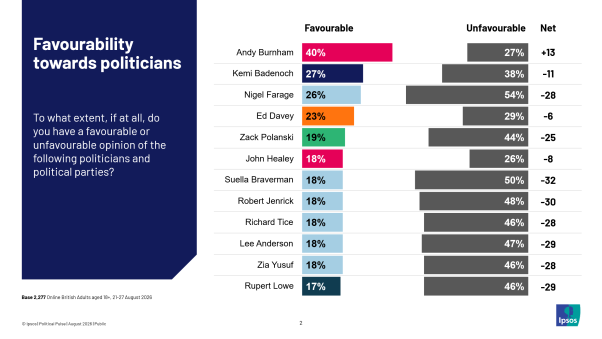
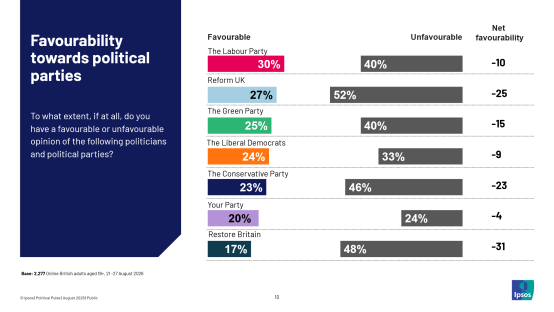
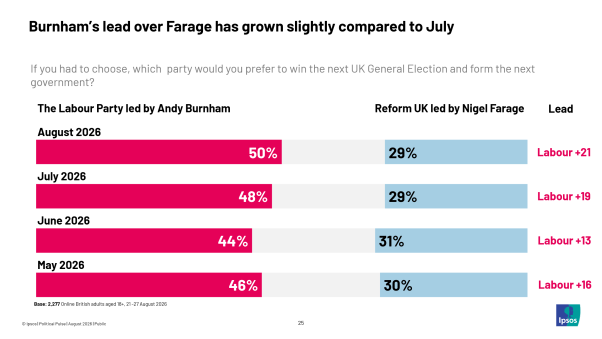
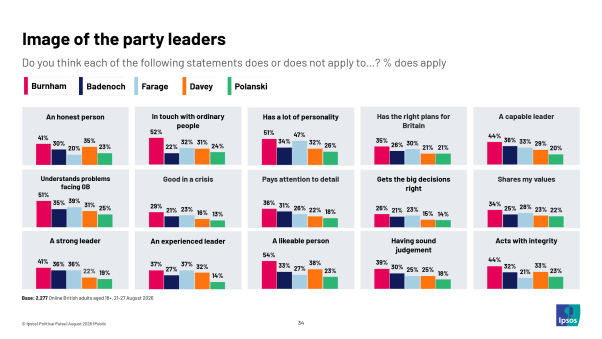
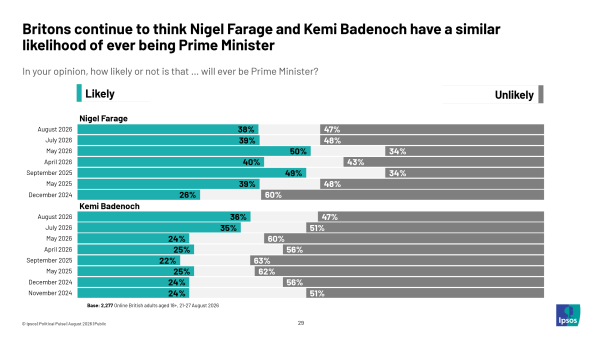
In the light of the upcoming by-election in our neighbouring borough of Camden I thought readers might be interested in this latest iPSOS Poll that took plce between the 21st and 27th of August,
|
From the ADCU
Londoners are being asked to trust a system without being given basic answers about who is responsible when something goes wrong. We have been asking these questions for months. If there is a collision, if a passenger becomes ill, or if a safety-critical decision has to be made, the public has a right to know exactly where liability sits and what status these so-called human safety drivers actually have."TfL requires licensed private hire drivers to pass stringent checks before they are allowed to carry passengers, including medical, safeguarding and regulatory requirements designed to protect the public. So the obvious question is: has that same standard been applied here? If the person sitting in the vehicle is meant to intervene in a safety-critical situation, or deal with a passenger emergency, Londoners need to know whether they have gone through the same licensing and vetting process as every other private hire driver in this city. If not, why not?”The platform companies, the Department for Transport and TfL need to answer these questions today. Until they do, we would not advise anyone to set foot in a driverless taxi.
Responding to reports that Uber will add driverless options for its customers in London, David McMullen, GMB Senior Organiser, said:
With hundreds of thousands of people employed to drive every day, we need to be really careful with the roll out of driverless cars unless we are prepared to see unprecedented levels of social and economic disruption.
GMB has called on TfL and the Government to urgently take responsibility for developing a plan that protects drivers and holds operators accountable for the disruption that these services will ultimately cause.
Until a plan is put in place to manage this transition and support drivers, it is premature to move to 'driverless' services.
It’s vital that we consider the implications of this before it’s too late.