Monday, 25 February 2013

Brent budget passed in the midst of indulgent pantomime

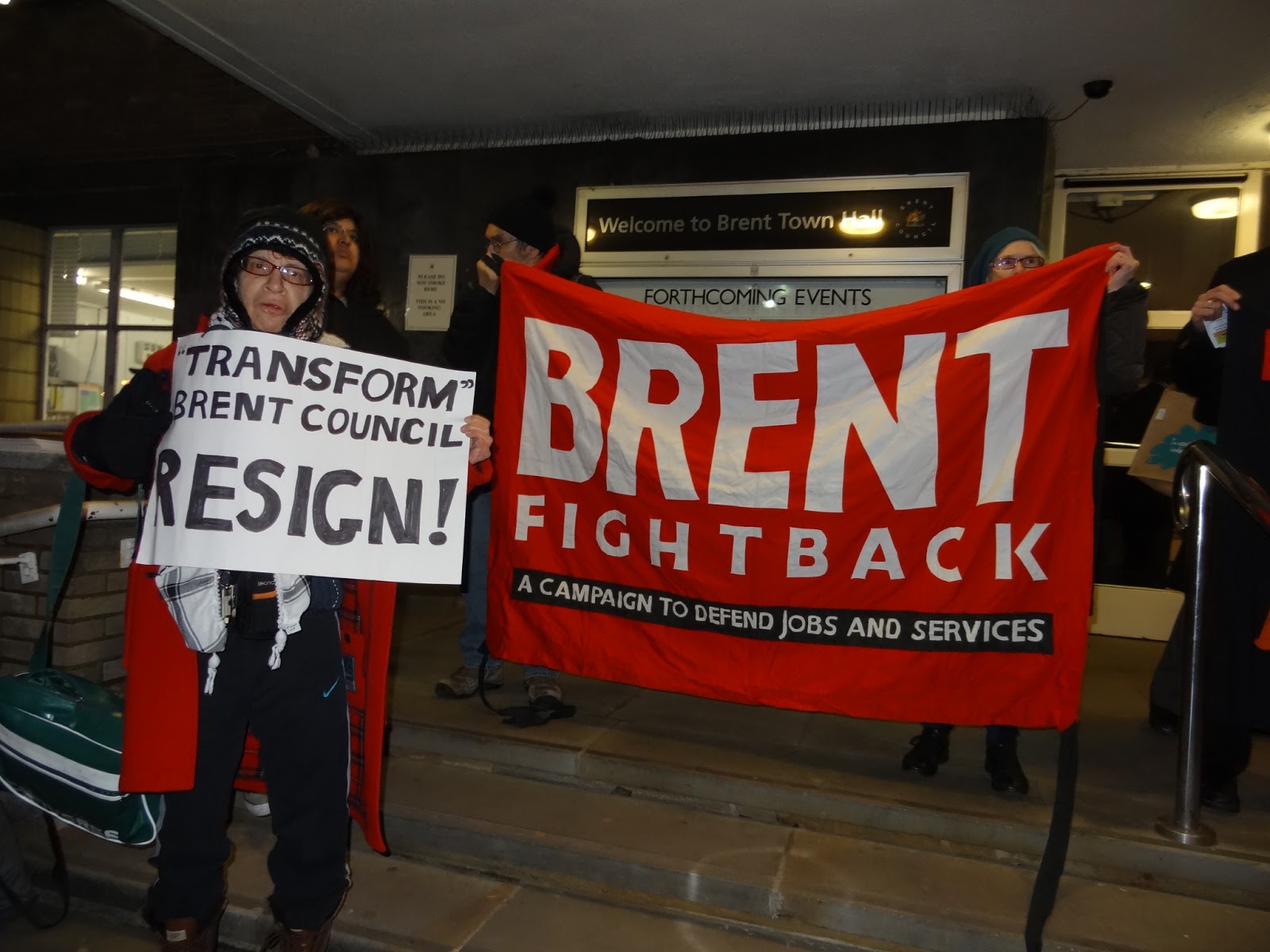
Protestors outside Brent Town Hall tonight
 Brent Council tonight approved Labour's budget which includes further cuts.  A last minute amendment moved by Council Leader Muhammed Butt aimed to spike the Opposition's guns by reducing parking charges at the cost of  reducing ward working funds by £210,000. £10,000 for each ward.

A previous last minute amendment at a Budget meeting by the then leader Ann John had doubled ward working funds. This time she spent the entire meeting reading what appeared to be a novel on her Kindle and made no contribution to the meeting.

The Lib Dem amendments which included £500k for volunteer libraries and reduced expenditure on the senior management team of the Council were voted down by Labour.  No Labour councillors challenged the budget despite cries of 'No Cuts' and 'Resign' from the public gallery.

Much of the meeting was taken up by the usual grand-standing speeches and barracking which Councillors seem to enjoy as a sort of Pantomime Politicians' Club but there was a measured, coherent contribution from Cllr Alison Hopkins in her role as Chair of the Finance and Budget Overview and Scrutiny Committee.

Her colleague Cllr Hunter drew disbelieving gasps when she appeared to suggest that the way to tackle child poverty in Brent was to  have more effective family planning now that the Council is in charge of public health. The Rev David Clues was not present but Cllr Gavin Sneddon made a sober speech criticising the pantomine and extolling the virtues of cross party cooperation.

When the vote was finally taken there was considerable confusion with some councillors heard to ask each other, 'What are we voting on? and it was certainly hard to follow the Mayor's chairing from the public gallery.

Below the surface of the debate loomed a recognition that next year's cuts of £19m (nearly 12% of the Council budget) will be disastrous. Perhaps, by then, the pantomime will have stopped.


The DfE's 'Big Sister' sends another disdainful missive to Gladstone Park


The lofty, superior and high-handed attitude of 'Big Sister' at the DfE can be seen in her latest letter to the Gladstone Park Primary Chair of Governors.

The letter written by Caroline Cane of the Brokerage and School Underperformance Division (now there's a friendly child-centred name for you) is notable for taking a swipe at the National Governors Association:
Firstly, I would like to make it clear that the National Governors’ Association (NGA) guidance mentioned in your letter is not statutory
As an independent body, the NGA’s views and advice do not necessarily reflect the Department’s position on how Academy sponsorship is brokered
So it is not only the governors at individual schools that are ignored but also their National Association. Remember, these are unpaid volunteers who give up hours of their time and despite the DfE's disdain are held accountable for the strategic and financial management of their schools with an ever-increasing workload. It is hard to discern any respect for this in Ms Cane's missive.

She goes on later in her letter:
With regards to your final point on consultation, the Department’s view on when this is most meaningful was set out in my letter of 24 January.  The legislative position on Academy consultation is defined in the Academies Act 2010, not guidance produced by the NGA.  The legislation states that ‘the consultation may take place before or after an Academy order, or an application for an Academy order, has been made in respect of the school.”
That is a wonderful definition of consultation. If it applied to the NHS the surgeon  could 'consult' with you about amputation after she had removed your leg!

It is clear the Big Sister always knows best:
Where a school is underperforming and eligible for intervention, it is not the case that schools are usually given a choice of sponsors. The Department leads on identifying potential sponsors as we have the complete view on individual sponsor's capacity and capability to deliver.
On the possibility of an arrangement with Queens Park Community School via the Cooperative College her remarks have a sting in the tail:
The Co-operative College is not an approved Academy sponsor and our records show we have not received an application from Queen’s Park School .  As a secondary school wanting to sponsor, its GCSE performance and Ofsted judgement would be taken into consideration.  It would also need to demonstrate that it has experience and a proven track record in working with and improving primary schools.  I note that in 2012 the percentage of pupils achieving 5+ A*-C GCSE’s including English and maths at Queen’s Park was 53%.  This is a drop of 9% percentage points compared to 2011 and means it is currently performing below the national average, so this school faces a number of challenges of its own

Brent Executive to agree Community Right to Challenge arrangements

The Brent Executive is to discuss the borough's policy on the Community Right to Challenge at its April Meeting.

Although it sounds like a right to challenge some of the more dubious decisions of the Council it is in fact the right of specific groups to bid to run current services which came into being under the Localism Act of 2011. It can be seen as a further move to end local government as we know it, introduction of the Big Society by the back door, and an escalation of out-sourcing. However, some Brent services such as the special needs playscheme are already run by such organisations.

This is some of the information already available elsewhere:
Only relevant bodies can make an Expression of Interest in running a service. The Localism Act lists the following as relevant bodies: 
  • A voluntary or community body
  • A body of persons or a trust which is established for charitable purposes only
  • A parish council
  • Two or more employees of the relevant authority
  • Any other person or body specified by the Secretary of State by regulations. 
A voluntary body is defined here as a body that is not a public or local authority, the activities of which are not carried on for profit. It can generate a surplus provided it is used for the purposes of its activities or invested in the community.  A community body is a body which is not a public or local authority, the activities of which are primarily for the benefit of the community. The definitions of a voluntary or a community body are intended to cover a wide range of civil society organisations. They reflect the required characteristics of such bodies rather than referring to your organisational structure. This allows for flexibility to accommodate future forms of civil society organisation. The way in which groups demonstrate community benefit will vary depending on their legal form and the associated requirements. The statutory guidance gives more information.
In fact Brent is behind other local authorities in publishing details on how it will administer the scheme. An officer in response to an FOI request earlier this year said the delay was due to officer sickness.

An example of an Expression of Interest form can  be found on the Haringey Council website HERE

It is likely that in the future this, along with the Community Right to Bid, Community Asset Transfer and Community Right to Build,  may be used by campaigners seeking to save local services but sustainability, as with the library volunteer bids, is likely to be a major issue.

Further information can be found at the My Community Rights website HERE 


Sunday, 24 February 2013

Trades Unions vital in the long march to equality- Green Party


The Green Party today put itself firmly on the side of the trade union and working class movement when they passed a motion moved by Pete Murry of Brent Green Party and the Green Party Trade Union Group, on the party's relationship with the unions.

The motion said in part:
The Green Part believes that the Trade Union movement plays a vital role in defending the interests of working people and continues to play a leading role in the long march towards equality and social justice in Britain and around the world. Therefore the Green Party encounters all its members to be active Trade Unionists wherever this is possible.