Showing posts with label Matt Kelcher. Show all posts

Thursday, 23 July 2026

Amidst over-development, a place to breathe and grow - South Kilburnites say 'SAVE OUR REC!'


The meeting at the Rec
 
 
From Save Our Rec
 
We hosted councillors from across the political spectrum, bringing together representatives from both Camden and Brent at the Granville Rec to amplify the #SaveTheRec campaign.
 
Leslie Barson met with Cllr Amer Agha (the Mayor of Brent), Cllr Matt Kelcher (Cabinet Member for Regeneration), and several Labour, Conservative, Lib Dem, and Green councillors.
 
Leslie highlighted why plans to demolish the Rec as part of the Hereford & Exeter regeneration project in South Kilburn must be urgently reconsidered.
 
*Loss of Public Space & Essential Amenities:*
Regeneration continues to erode crucial public and open spaces, leaving the Kilburn community with fewer vital local amenities.
 
*A History of Broken Trust:*
Decades of Brent Council failings in South Kilburn have severely damaged community trust, making transparent and genuinely accountable decision-making essential.
 
*Inadequate Replacement Site:* 
The proposed replacement site is simply not an equivalent alternative for a whole host of reasons.
 
*Lack of Community Participation:*
Meaningful consultation and true community participation have been consistently sidelined throughout this process.
 
Environmental & Wellbeing Impact:
 
🌱 *Community & Food Sovereignty*: It is an active community garden run by Granville Community Kitchen, providing local food growing, City & Guilds horticultural training, and educational workshops.
 
*🧠 Mental Health & Wellbeing:* It offers a calm, essential green sanctuary for local school pupils, young people, and residents.
 
🐝 *Vital Biodiversity:* It is a mature, irreplaceable urban ecosystem, not a space that can simply be replaced by concrete or artificial landscaping.
 
⚠️ WHAT YOU CAN DO


There is a Brent Councillors’ Members Briefing tomorrow. 
 
We are calling on *all* local residents concerned about the loss and overdevelopment of our green spaces to take action NOW:
 
1️⃣ Email your Ward Councillors: Ask them directly to attend tomorrow’s briefing and stand up for South Kilburn’s green infrastructure.
 
2️⃣ Send an Email / Message: If you believe in saving the Rec, contact:
 
 Cllr Rubin (Cabinet Member for Action on Climate)
 
 
Cllr Kelcher (Cabinet Member for Regeneration)


Useful Links & Petitions:


📌 Brent Green Party Campaigns: https://brent.greenparty.org.uk/campaigns/
 
Please share this message with your local Kilburn and Brent networks, street groups, and neighbours! 💚✊

Friday, 17 July 2026

Key questions remain unanswered about the Health & Wellbeing Hub in Gladstone Park


The proposed building

The proposed Health and Wellbeing Hub  in Gladstone Park has aroused some strong feelings on either side with debate on Wembley Matters and Next Door. In particular read the comments as well as the Letters:    LETTER: We have not been told the whole story about the Gladstone Park Health Hub and  LETTER: Gladstone Park Medical Centre - Is there a Phase 2? What is it?

Cllr Mary Mitchell, Green councillor for Willesden Green ward where the Hub is planned to be situated, has been carefully considering the issues involved.

Cllr Mitchell writes:  

As Brent Council prepares to consider plans for a new Health and Wellbeing Hub in Gladstone Park, I have written to the Leader of the Council, Cabinet Members and the Chair of the Planning Committee to set out a number of concerns that I believe should be addressed before the application is determined.

To be clear, I support the expansion of local GP services and recognise the need for improved healthcare provision across Brent. However, I am not yet convinced that building on Metropolitan Open Land is the only way to achieve this.

My letter calls for greater transparency over how the site was chosen, fuller assessment of alternative locations, clearer evidence of the project’s environmental and community impacts, and a more informed public consultation before decisions are taken on the use of protected public land and nearly £3 million of public funding.

I hope the letter contributes constructively to the debate and helps ensure that residents have access to the information they need as this important planning application progresses.

Full text below:


To Cllr Muhammed Butt, the Leader of the Council, Cllr Saqib Butt, the Chair of Brent Planning Committee, Cllr Matt Kelcher, Lead Member for Planning and Regeneration, and Cllr Liz Dixon, Lead Member for Community Safety and Public Health.


As we imminently expect the submission of the full planning application for the proposed Willesden Health and Wellbeing Hub in Gladstone Park, I wanted to set out my concerns, building on those I raised in my emails of 26 March and 28 April to the former Cabinet Member for Regeneration.

I fully recognise the need to expand GP provision in Cricklewood, Willesden Green and across Brent and support these efforts. However, there are a number of significant concerns that this plan raises, which I hope can be addressed through the provision of additional information to support the planning process, and made public to residents to ensure adequate transparency and scrutiny.


I believe that the Planning Committee should seek the following information before determining the application.


1. Confidence in the assessment of alternative sites


The proposed site is the former Gladstone Youth and Community Centre at 162 Anson Road, adjacent to the children’s playground. Although buildings currently exist on the site, it is designated Metropolitan Open Land.


Metropolitan Open Land benefits from the highest level of planning protection in London with Policy G3 of the London Plan affording MOL the same level of protection as Green Belt. Any proposal seeking to override that designation on the basis of “very special circumstances” must therefore be supported by compelling evidence and subject to exceptional scrutiny. Although every planning application must be determined on its own merits, approval of development on MOL in this instance would inevitably be cited in future proposals affecting similarly protected land.


At a time of increasing biodiversity loss, urban heat stress and surface water flood risk, it is essential that this designation is only overridden where the justification is clear and robust. It is therefore essential that the evidence underpinning site selection is robust, up to date and available for public scrutiny.


The Committee should require publication of a more recent NHS Estates options appraisal demonstrating why this site is the only viable location. The most recent feasibility work referenced dates from 2023 and, importantly, Brent Council confirmed on 14 May by email that it “does not hold the full NHS/applicant site-wide assessment or options appraisal.” It is difficult to conclude that the “very special circumstances” test has been met if the underlying evidence is unavailable.


The Council should also demonstrate that it has independently assessed alternative locations rather than relying solely on the NHS Estates process. If it is prepared to provide public land to facilitate the relocation of Willesden Green Surgery, it should be able to evidence that no other suitable site exists to serve residents in the Church End, Neasden Stations and Staples Corner growth areas.


In particular, I would welcome an explanation of why this flagship Integrated Care Centre cannot be accommodated within one of Brent’s designated regeneration areas. 


For example, Site Allocation BSSA2 within the Church End Growth Area Masterplan already identifies provision for a 1,855m² health facility. Likewise, the Council should explain why existing assets, such as the former Neasden Library within the Neasden Growth Area, have not been considered appropriate alternatives.


The Committee should also clarify why a single flagship practice serving upwards of 20,000 patients is considered preferable to a distributed “hub and spokes” model using smaller premises, potentially including Council-owned buildings such as 395 Chapter Road, a designated health centre that currently stands empty. Such an approach could reduce travel distances for patients while aligning with the Government’s “Health on the High Street” agenda.


2. Transparency about the scale and type of the proposed development, and the decision-making process that has led to this partnership between the Council and the Willesden Green Surgery

The Committee should receive full transparency regarding the process through which this site was selected and the basis upon which a 150-year peppercorn lease is proposed, enabling a private enterprise to profit from public land.


Given the value of both the public land being given to the GP practice with no yearly rental costs, and the proposed £2.97 million Strategic Community Infrastructure Levy allocation, residents are entitled to understand on what basis this offer was made, and whether this financial subsidy was also offered to other GP practices to enable their growth.


The patient catchment should also be clarified. Residents should note that the consultation catchment was amended only two days before the close of the initial consultation period, on 30 March, to include a 1.5-mile catchment area. This inevitably affects how residents interpret the scale and impact of the proposal.


Wider detail of how this site has been assessed and fits into the wider healthcare picture for Brent would increase transparency and help to provide confidence in this plan. Is this Hub designed to be a Neighbourhood Health Centre (with a minimum patient roll of 30,000 patients)? Guidance from NHS England on Neighbourhood Health Centres (NHCs) in April 2026[1] states that where new build centres are proposed, locations including town and local centres and high streets should normally be preferred.

Where a new NHC is proposed away from an existing community focal point, a local authority assessment may be provided. There are requirements for Integrated Care Boards to propose a pipeline of NHCs and how they are organised across the footprint to deliver effective clinical strategies. If these activities have taken place, they have not been made public.


Furthermore the ongoing financial management and governance of the NHC should be made available, so as to assess the Council’s role in financially supporting it. It is noted that there is no reference to the establishment of an NHC in any public papers from the Brent Health & Wellbeing Board, Brent Primary Care Executive Group, or the North West London Integrated Care Partnership board meetings as would reasonably be expected.


3. A full assessment of impact


Before determining the application, the Committee should require a comprehensive Travel Plan demonstrating how patients from Church End, Staples Corner and the wider catchment will access the site. This should assess public transport, walking routes, parking demand and traffic impacts. 

For some patients, particularly those with mobility issues, attending appointments may require multiple bus journeys despite the proposal being intended to improve access to healthcare.


The application should also include a robust assessment of footfall on the park and the local area and knock-on impacts such as littering. The proposal represents a significant change in the use of the site, from recreation and community use to a healthcare facility operating seven days a week, employing between 50 and 100 staff and potentially attracting up to 1,000 visitors each day.


Although the building is intended to achieve a high BREEAM standard, this should not substitute for assessing the wider environmental impacts of the development itself. Construction impacts, biodiversity, urban heat, carbon emissions and surface water flood risk all require careful consideration, particularly as the site is identified as being at high risk of surface water flooding.


4. An updated and comprehensive view of community benefit


The proposal also involves the permanent loss of an existing community site on open public land. While the current buildings are no longer fit for purpose, this reflects decades of underinvestment rather than an absence of community need. The former community centre, with estimated repair costs of around £410,000, could potentially have been refurbished or repurposed to meet any of the very real community needs residents in Willesden Green and Cricklewood have, including youth services and recreation. This proposal should therefore be considered in the wider context of Brent’s continuing loss of community assets, including libraries and community centres.

The Committee should seek updated proposals for the café and first-floor community space, reflecting the feedback received during consultation. Although Cabinet has already approved £2.97 million of Strategic Community Infrastructure Levy funding, the planning process should still consider whether the community facilities genuinely reflect identified local need.


Residents are entitled to understand why this represents the best use of almost £3 million of developer contributions when alternative investments across Willesden Green and Cricklewood, including youth provision, crime prevention initiatives and the refurbishment of existing community facilities, could potentially deliver greater community benefit at significantly lower cost.


5. A new consultation process


Finally, I hope the Planning Committee will ensure that residents are able to comment on the application with all the relevant evidence before them. Without the Travel Plan, assessments of footfall and environmental impact, and with the patient catchment only expanded towards the end of the original consultation period, it is difficult to conclude that residents participating in the first stage of engagement were fully informed.


If Brent Council continues to support this scheme, including through the allocation of £2.97 million of Strategic Community Infrastructure Levy funding and the proposed grant of public land through a long-term peppercorn lease, I would encourage those who have championed the project including the Leader of the Council and the Cabinet Member for Regeneration and Planning to engage directly with residents during the planning process. To date, much of the public advocacy has fallen to the Willesden Green Medical Practice. Those responsible for the Council’s decisions concerning public land and public funding must be prepared to explain and defend those decisions openly.


I remain fully supportive of expanding healthcare provision for Brent residents. However, I am not yet persuaded that the Council has demonstrated why this development must take place on Metropolitan Open Land, why alternative sites have been discounted, or why this proposal represents the best use of both scarce public land within the boundaries of a much used and much loved local park and £2.97 million of Strategic Community Infrastructure Levy funding.


I hope these issues will be addressed before the application is determined, and I look forward to continuing to engage constructively throughout the planning process to ensure that Brent delivers both the healthcare facilities and the public spaces that our growing communities need.


Yours sincerely


Councillor Mary Mitchell


Ward Councillor for Willesden Green


Tuesday, 14 July 2026

Guest Post: Tech Giants, the CNI "Loophole," and the Battle for Park Royal’s Environmental Future


Image from actonw3


Guest post by Olivia Law-Zygadlo

A major planning battle is brewing on the borders of Brent and Ealing that should concern every resident who cares about local democracy, corporate transparency, and the air we breathe.

This Friday, July 17th, residents from North Acton’s Wesley Estate will protest a proposed mega-data centre at the Frogmore Industrial Estate (NW10 7NQ). Modern data centres are notorious energy drains, requiring immense power grids and cooling systems that create persistent noise and strain local infrastructure. Residents are rightfully demanding that the Old Oak and Park Royal Development Corporation (OPDC) enforce strict environmental protections and mandate transparent air quality monitoring from Brent and Ealing councils.

However, this local planning application highlights a broader national issue.

The CNI "Shield"

Increasingly, tech infrastructure operators are using Critical National Infrastructure (CNI) designation to bypass standard planning scrutiny. Since the government designated the UK data centre sector as CNI in September 2024, operators have leaned on this status to secure smoother planning treatment.

If planning authorities treat sector-wide CNI status as a reason to lower environmental scrutiny, it sets a dangerous precedent. When operators like Kao Data invoke "national security and vital infrastructure," they effectively create a against local accountability. Our message to the OPDC and the national government must be uniform: there should be no CNI-linked planning advantage without mandatory green standards. If the sector is critical enough to sit alongside water and energy providers, protecting local air quality and the climate must be a non-negotiable condition.

The Role of the OPDC and Cllr Matt Kelcher

Because this development sits within the multi-million-pound Park Royal regeneration zone, the ultimate planning and development authority does not rest with standard council planning boards. It rests with the Old Oak and Park Royal Development Corporation (OPDC). 

This brings us to a familiar face in Brent politics: Councillor Matt Kelcher.  


Not only is Cllr Kelcher  Brent's Cabinet Member for Regeneration and Planning, overseeing major local development portfolios, but he was a long-serving voting member of the OPDC Planning Committee, representing the interests of the London Borough of Brent, where portions of the OPDC boundary fall, during the critical early stages and milestone planning decisions for these major local developments


A key question from residents is whether Cllr Kelcher will declare and recuse himself from regeneration and planning decisions given his professional role at TheCityUK. While TheCityUK represents the financial and professional services sector rather than the data centre industry itself, its membership consists of the UK’s largest consumers of digital infrastructure, who rely heavily on data centres to manage risk, host digital services, and process high-volume financial transactions. Residents are asking whether this close alignment between his professional focus and the heavy reliance of his members on data capacity creates a perceived conflict of interest with his impartial responsibilities on the OPDC planning committee.


CAMPAIGN WEBSITE 

Tuesday, 5 May 2026

The 'other' Matt Kelcher


We know Matt Kelcher as the three-term councillor for Harlesden and Kensal Green, and latterly as the chair of Brent Planning Committee, with his introductory homily on the importance of meeting the borough’s house building target and the current housing emergency.


He has another life, in the small print of the Council’s Register of Interests but not declared this at Planning Committee meetings. Kelcher is the Director of Public Affairs at TheCityUK, described by Reuters as ‘Britain’s most powerful financial lobby group’. His work, as a member of Chartered Institute of Public Relations, is to advocate for members of TheCityUK.


Matt Kelcher is also a Brent councillor on the multi-million Old Oak and Park Royal Development Corporation where his connection with TheCityUK is also declared LINK.


Where does this overlap with his councillor role?


A clue lies in one of his more recent articles for TheCityUK blog. ‘Reforming the UK’s planning system: a path to growth’.  Locals who have spoken against planning applications at Planning Committee may have picked up a polite lack of sympathy for their presentations and the extracts from his article below makes clear that he sees the need for a more robust assumption of assent for applications:


A lack of consistency between (and within) local planning authorities is creating uncertainty and unpredictability in decision-making. One way to maximize the value added by England's new metro mayor model would be to explore allowing mayors to designate zones with a much greater presumption of planning approval. The UK's current planning regime of application and appeal is an international outlier, and its delivery has presented challenges to the building of homes and infrastructure.


To make the UK more attractive to investors and facilitate investment decisions, the planning process needs to prioritize efficiency and timely decisions. One mechanism to achieve this would be to streamline the statutory consultation process, with a greater assumption of assent from consultees who do not reply to local authorities within deadlines.


Cllr Kelcher is an ally of the former Shama Tatler (now Baroness Shah of Wembley) and active within the Labour Party in the drive for accelerating house building, which in Brent has resulted in unaffordable luxury high rise towers.  He is a member of her Labour YIMBY group (Yes in My Backyard). The group was set up to oppose those who raise concerns about over-development, density, and lack of affordability in new developments – stereotyped as NIMBYs (Not in My Backyard). They rely on a ‘market model’ belief that increased supply will result in reductions in house prices and rents – not something we have seen in Brent where according to the London Renters Union rents have increased by 27% over the last 3 years despite all the new units built.


‘Proudly YIMBY Proudly Labour’


Tribune magazine in an August 2025 article LINK wrote:


One of the core principles of YIMBYism is ensuring easier access to property ownership and wealth accumulation. Yet, bizarrely, advocates refer to themselves as ‘housing activists’ and think of themselves as ‘campaigners’ embedded in a ‘pro-housing’ movement. They might choose to adopt the language of those on the front line of the housing emergency. But in reality, their natural habitat is the boardroom — and buffet lunches with developers.


Tongue in cheek they suggest that alongside NIMBY and YIMBY, there should be PHIMBY – Public Housing in My Backyard.


If a Brent planning application had been made by any of his TheCityUK employer’s clients, Kelcher would have had to declare his interest. ‘Pre-determination’ is a slippery term in planning circles and refers to a member of a planning committee having made up their mind in advance of hearing an application. I have no evidence that this applies to Matt Kelcher’s many specific decisions at Planning Committee, but his pre-disposition to approve applications in more general terms is, perhaps, clear.


Matt Kelcher’s record:  Source Open Council Network


Published and promoted by Jmes Paton on behalf of  Brent Green Party c/o 23 Saltcroft Close, Wembley, HA9 JJ 


Saturday, 20 May 2023

Brent Council leader Muhammed Butt accused of having Scrutiny chairs 'in his pocket'

The Annual Meeting of Brent Council which had proceeded with its ceremonies as expected burst into life this week when it considered a Liberal Democrat amendment to the Council Constitution based on their interpretation of the 2017 recommendations of the  House of Commons Communities and Local Government Committee on 'Effectiveness of local authority overview and scrutiny committees '(Extract above) Link to full report.
 
Cllr Georgiou moving the amendment said that that there needed be a real and visible indpendent role for scrutiny and proposed that Scrutiny Committe recommendations should be discussed at Full Council, rather just Cabinet. Further, the Liberal Democrats felt that just having two scrutiny committees, unlike some other councils, meant that their agenda were too packed for effective scrutiny. They proposed a further 3 scrutiny committes to spread the load and make scrutiny more effective. Given the political makeup of the council 3 should be chaired by Labour councillors and the other 2 by a Liberal Democrat and a Conservative  councillor. The leader of the Conservative group backed the call.


Responding, Brent Council leader Cllr Muhammed Butt said that this was a Labour Council chosen by the people of Brent. Gesturing to his Labour colleagues he said that on his side of the chamber 'we have the people's choice', and went on:

I have two great Scrutiny Chairs who are doing a superb job...we have no need to make any changes.

The Liberal Democrats had not taken account of the expense and officer time need for 3 more committees when there were financial constraints. The Labour Group would oppose the amendment.


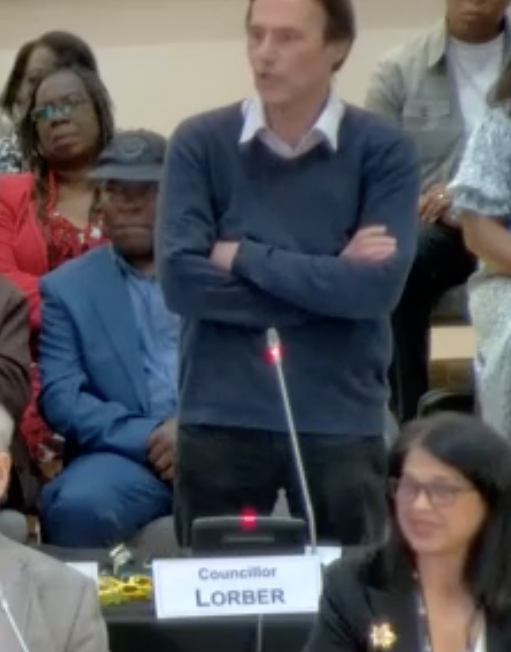
Exercising the Lib Dem's right of reply Cllr Paul Lorber said:
Thank you for the advert for democracy in the borough.
He then jumped on the possessive ' I ' that Butt had used and asked, 'Are they [scrutiny chairs] excellent because they are independent or because they are in your pocket? Which is it Cllr Butt?'

Addressing all the councillors he said that non-executive councillors all had a responsibility to ensure there was effective scrutiny:

If the leader of this council has 'my' chairs of scrutiny in his pocket there can be no confidence that the scrutiny process is independent and fair because of the words he used. Because of the words of the leader we now know that scrutiny is a rubber stamping of everything, a 'yes' to everything and no effective scrutiny.
 
Cllr Miller raised a point of order asking that the Mayor (chairing her first council meeting)  should make Cllr Lorber apologise for his 'unparliamentary' language but this was ruled out on a technicality by the council's legal advisor.
 
Cllr Kelcher, chair of the planning committee, raising another point of order/information said that the chairs of scrutiny were elected  within the Labour Group on a vote that excluded members of the executive. Therefore a misleading picture had been painted about their independence.
 
The motion was put to the meeting and lost with as far as I could see only Lib Dem and Conservative councillors voting for it.
 
A  futher Lib Dem amendment on  the 6 Brent Connects area suggested that Wembley being much larger that the two others should be split into 2.  In addition, reflecting the  political representation in the areas that one of the Wembley areas should be chaired by a Lib Dem councillor and the kingsbury and Kenton by a Conservative councillor.

That amendment was also lost so the 5 Brent Connect areas remain chaired by Labour councillors.
 
 
 Extracts from the House of Commons Report (LINK)

We have found that the most significant factor in determining whether or not scrutiny committees are effective is the organisational culture of a particular council. Having a positive culture where it is universally recognised that scrutiny can play a productive part in the decision-making process is vital and such an approach is common in all of the examples of effective scrutiny that we identified. Senior councillors from both the administration and the opposition, and senior council officers, have a responsibility to set the tone and create an environment that welcomes constructive challenge and democratic accountability. When this does not happen and individuals seek to marginalise scrutiny, there is a risk of damaging the council’s reputation, and missing opportunities to use scrutiny to improve service outcomes. In extreme cases, ineffective scrutiny can contribute to severe service failures.


Our inquiry has identified a number of ways that establishing a positive culture can be made easier. For example, in many authorities, there is no parity of esteem between the executive and scrutiny functions, with a common perception among both members and officers being that the former is more important than the latter. We argue that this relationship should be more balanced and that in order to do so, scrutiny should have a greater independence from the executive. One way that this can be achieved is to change the lines of accountability, with scrutiny committees reporting to Full Council meetings, rather than the executive. We also consider how scrutiny committee chairs might have greater independence in order to dispel any suggestion that they are influenced by partisan motivations. Whilst we believe that there are many effective and impartial scrutiny chairs working across the country, we are concerned that how chairs are appointed can have the potential to contribute to lessening the independence and legitimacy of the scrutiny process.


The Centre for Public Scrutiny states that:

Legally, the Chairing and membership of overview and scrutiny committees is a matter for a council’s Annual General Meeting in May. Practically, Chairing in particular is entirely at the discretion of the majority party.


Majority parties can, if they wish, reserve all committee chairships (and vicechairships) to themselves ... the practice of reserving all positions of responsibility to the majority party is something which usually happens by default, and can harm perceptions of scrutiny’s credibility and impartiality.


Chairs from a majority party that are effectively appointed by their executive are just as capable at delivering impartial and effective scrutiny as an opposition councillor, but we have concerns that sometimes chairs can be chosen so as to cause as little disruption as possible for their Leaders. It is vital that the role of scrutiny chair is respected and viewed by all as being a key part of the decision-making process, rather than as a form of political patronage.


Newcastle City Council where all scrutiny chairs are opposition party members, states that:

This has taken place under administrations of different parties and we believe that it adds to the clout, effectiveness and independence of the scrutiny process; it gives opposition parties a formally-recognised role in the decision-making process of the authority as a whole, more effective access to officers, and arguably better uses their skills and expertise for the
benefit of the council.


Thursday, 8 April 2021

Brent commits to work with Brent Friends of the Earth/Divest Brent towards divesting its Pension Fund from fossil fuels


From Divest Brent/Brent Friends of the Earth

For over 3 years campaign group Divest Brent have been working to persuade the Council to divest its Pension Fund from fossil fuels. On April 6 Councillor Matt Kelcher presented the 1,400-signature petition (including 1,200 Brent residents) to the Cabinet on behalf of Divest Brent.  


Coming as it did immediately before the Cabinet discussed its 10-year climate strategy Councillor Kelcher’s hard-hitting presentation carried added weight. Following campaigning by Divest Brent the draft strategy, which was agreed at the meeting, included a section on the Pension Fund’s investments.


Responding to the presentation, Council Leader Muhammad Butt, Deputy Leader Margaret McLennan and Environment lead, Krupa Sheth all spoke positively and in particular Councillor McLennan looked forward to working with Divest Brent and Brent Friends of the Earth to take the agenda forward.


In 2019 the Council declared a Climate and Ecological Emergency and specifically agreed to redirect investments to renewable, sustainable and low carbon funds. Indeed some investments have been made in this area but the majority of the Pension Fund is still invested in funds which include fossil fuels.


Simon Erskine, Co-ordinator of Divest Brent, said “We welcome any moves by the Pension Fund to invest sustainably and to help with the transition to renewable energy – but the fact is that whatever green investments the Fund may have, while it continues to invest in fossil fuels it is part of the problem. We therefore look forward to working with the Council to develop a road-map for divestment in the short term.”


The presentation of the petition comes hot on the heels of a report entitled “Divesting to protect our pensions and the planet” which gave a comprehensive breakdown of the extent that UK Councils were invested in fossil fuels. 3% of Brent’s Pension Fund is thought to be invested in fossil fuels - £26 million. Compared to the £40 million invested in 2017 this looks like an improvement – until it is realised that much of the reduction is due to a fall in value of fossil fuel investments.


The Council has admitted that, while much of the Stock Market has suffered from Covid 19, they have lost £8 million by failing to divest from fossil fuels before the pandemic. They are not alone in this – with UK Councils having lost £2 billion altogether over the last 4 years – but £8 million is still a serious loss compared to the Pension Fund total of £800 million.


With the outlook for fossil fuels never worse as the electric vehicle revolution starts to kick in and governments look to move away from gas as a means of heating our homes, Pension Fund committee members could find themselves in breach of their duties to protect the value of the Fund if they do not start to move seriously towards divestment. Said Mr Erskine, “We look forward to Brent joining Lambeth, Southwark and Islington Councils (to name just a few) in committing to divest its pension fund from fossil fuels.”


Tuesday, 6 April 2021

Divestment from fossil fuels - Cllr Matt Kelcher: 'We should do it NOW, when we can make the biggest impact'


The presentation and discussion of the Divest petition

Cllr Matt Kelcher today presented a petition of nearly 1,400 Brent residents calling for Brent Council to divest its pension fund from fossil fuels. In the video above you can see him outline why investing in fossil fuels is bad policy, bad economics and bad politics. He said local people feel strongly about the issue in the light of the climate emergency and Brent Council should follow the lead of 9 Labour boroughs with divestment policies,. 'Not to divest makes us part of the problem and not part of the solution...We should do it NOW, when we can make the biggest impact.' 

In her response Cllr McLennan (Deputy Leader and lead for resources) offered to  work with Divest Brent and Friends of the Earth on the issue.

Tuesday, 3 March 2020

Councillors move to improve Brent Council's scrutiny process


Scrutiny is more than just a band!
Following my article about failures in Brent Council scrutiny processes LINK local resident and Wembley Matters contributor Philip Grant took up the issue with councillors. Concerns centred around the Council not meeting the standards outlined in the Centre for Public Scrutiny's  Good Scrutiny Guide.  Indeed the Resources and Public Realm Scrutiny Committee's Recommendation Tracker showed only ONE response from the Cabinet to the Committee's 18 reports for 2019-20 and that was merely to 'note' the committee's recommendations on the vital issue of air quality, rather than provide any responses and action commitments.

The Community and Wellbeing Scrutiny Committee does not appear to have a Recommendation Tracker so it is difficult to assess the impact of its recommendations which are often made after very detailed questioning of officers and lead members. At the last meeting which I attended the committee members did not raise any issuers under 'Matters Arising' from the Minutes which would be one way of checking on any actions arising from recommendations.

These are the responses Philip  Grant has received which indicate that the matter is being considered by at least two councillors.

Philip writes:

Cllr. Miller  Lead Member for Community Safety and Engagement, responded to my email  but he did not say whether he was writing on behalf of the Council Leader and fellow Cabinet members, or just in a personal capacity.

Among the points in his email, I welcome his statement that:
'I wish to agree with the point that Scrutiny reports should not simply be ‘noted’. Often when there are 20+ recommendations etc it can be difficult to go into great detail in responding, but generally where an action or decision is requested I feel that the cabinet should record its response, if not its basic reasoning.'
He went on to say:
'... if cabinet disagrees with a scrutiny recommendation, then we should make an effort to say why. My officers will shortly report back to the Chair of the knife crime scrutiny task group, Cllr Kabir, on progress against her report recommendations, for this reason. I would like to see this embedded in our practice more officially.'
I have replied to Cllr. Miller, saying:
'I welcome your agreement that the Cabinet should do more than just "note" recommendations from Scrutiny Committees. The findings of those committees, who have the time to consider particular issues far more closely than the Cabinet can do, should be respected and implemented by the Leader and Cabinet, unless there are very good reasons why that should not be the case. Scrutiny is one of the important "checks and balances" which a well run Council democracy needs.'
Hopefully, the points raised by Councillors Nerva and Mashari at the Resources and Public Realm Scrutiny Committee meeting on 29 January, and Martin's highlighting of them , will see better treatment by Brent's Cabinet of recommendations by the Scrutiny Committees in future.

I have received the following email from Cllr. Matt Kelcher, Chair, Resources and Public Realm Scrutiny Committee, which suggests that Martin's efforts in highlighting this matter in his blog, and mine in sharing my concerns with councillors, may not have been a waste of time:
'Thanks for your continued interest in this matter:
I have had several meetings on the subject with the most senior officers in the last couple of weeks. I can assure you that it is something I take very seriously.

A new system will be in place for the next couple of meetings of my committee and I am sure you will see a significant improvement.'