Friday, 3 April 2026

Socialist Health Association: Why We Stand With Resident Doctors

 Reprinted with the permission of the author and Labour Hub. Original article HERE.


This dispute is about patient safety, not just pay, argues Dr Rathi Guhadasan, writing on behalf of the Socialist Health Association.

The headlines tell one version of this story: disruption, cancelled appointments, patients stuck in the middle. It’s understandable that the government’s position resonates with many people. But headlines don’t tell the whole story.

If we’re serious about what’s good for patients in the long run, we can’t stay silent. We support the BMA’s resident doctors in their dispute with the government — and here’s why.

Fifteen Years of a Shrinking Pay Packet

This dispute didn’t start in 2025. The roots go back to 2008, when pay policy began quietly — but steadily — chipping away at what resident doctors actually earn in real terms.

Measured against the Retail Price Index — which includes housing costs and student loan interest, two of the biggest financial pressures on junior doctors — pay has fallen by roughly 22% in real value since 2008/09. Even Full Fact, the independent fact-checking organisation that questioned the BMA’s preferred measure, still agrees that pay has fallen in real terms. 

Whichever way you count it, doctors’ spending power has been steadily eroded over more than a decade.

The low point came in 2022/23, when the BMA estimated the real-terms loss had reached around 29%. Strike action in 2023 forced movement. The deal struck with the newly elected Labour government in September 2024 included a combined pay uplift of 22.3% across 2023/24 and 2024/25 — though it’s worth noting that part of this had already been awarded under the previous Conservative government.

Despite those rises, resident doctors’ pay in England remained around 20.8% below where it was in 2008. The 2024 deal was progress — but it wasn’t the finish line.

Then came Labour’s offer for 2025/26: a 5.4% rise recommended by the independent pay review body. The BMA argues this still represents a real-terms pay cut when set against actual inflation. Their position is that a 26% uplift on 2024/25 basic rates is needed to fully restore pay.
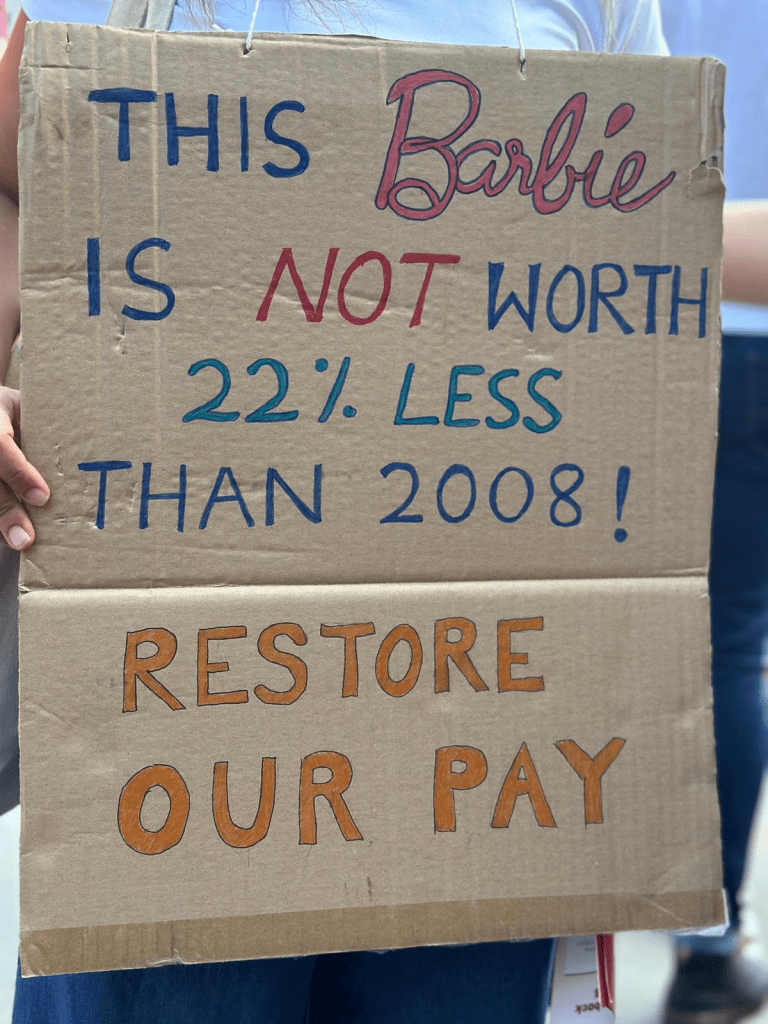
 

This pay gap wasn’t created by doctors. It was created by successive governments — Conservative and Labour — repeatedly choosing to let doctors’ pay fall behind the cost of living. Asking doctors to simply accept that as permanent isn’t fairness. It’s making them foot the bill for political decisions they had no part in.

The Career Bottleneck: Too Many Doctors, Too Few Opportunities

Pay is only part of what’s at stake here. There’s a second issue — one with even deeper implications for the care patients receive.

After their initial training, junior doctors must compete for specialty training posts — the pathway to becoming a consultant, a GP, or a surgeon. In 2019, there were roughly 1.4 applicants for every available training post. By 2025, that ratio had surged to more than 5 to 1. In some specialties, the figures are startling. Over 10,000 doctors applied for psychiatry training posts in 2025 — fewer than 500 places were available, amidst a national crisis in mental health care. Five doctors applied for every GP training post, at a time when millions of patients across England are struggling to get a GP appointment at all.

How did this happen? The previous Conservative government expanded medical school places without creating a matching expansion in specialty training posts. At the same time, overseas recruitment was increased — without addressing the underlying shortage of training posts. The predictable result: thousands of doctors unable to move forward in their careers, or unable to find posts at all.

This isn’t just a career problem for individual doctors. It has direct consequences for patients. The Lancet has warned that the consultant bottleneck alone could leave up to 11,000 posts unfilled by 2048. The NHS is training doctors it cannot then absorb into the senior roles they were trained for — while using less-qualified staff to plug the gaps those doctors could fill, if only the training posts existed.

The government’s response was to pass the Medical Training (Prioritisation) Act in early 2026, giving UK medics priority in competing for these posts. But overseas-trained doctors have been a vital lifeline for the NHS, filling critical gaps that the domestic system failed to plug. The answer is not fewer doctors but a dramatic expansion of the training posts needed to develop the service we need, one that is fully resourced and fit for the 21st century.

And legislation about who gets to compete for too few positions doesn’t solve the problem – for doctors or patients. As one surgeon put it in parliamentary debate: “If we increase the number of trainees, we will also need to increase the number of consultants and GPs. If we do not do that, we will simply push the bottleneck down the road.”

The Substitution Problem: Who Is Actually Treating You?

Here’s the part of this crisis that gets the least attention — but as patients, should scare us most of all.

Across the NHS, physician associates (PAs) and anaesthesia associates (AAs) are increasingly being used to fill roles that have traditionally been carried out by doctors.

PAs typically hold a two-year postgraduate qualification. They cannot prescribe medication independently and they cannot make admission or discharge decisions on their own. They are not doctors. Yet in too many NHS trusts, they have been placed in clinical roles that require a doctor’s training, a doctor’s legal accountability, and a doctor’s level of skill — at a lower cost to the employer. The previous government planned for 10,000 PAs in the NHS by 2036/37 and Labour so far has stuck to this plan.

This isn’t a fringe concern. A BMA survey of more than 18,000 doctors found that 87% believed the way PAs currently work poses a risk to patient safety. The case of Emily Chesterton — a 30-year-old woman who died after being misdiagnosed by a PA she believed to be her GP — brought these concerns into sharp public focus.

In response, the Royal College of General Practitioners withdrew its support for PAs in primary care in September 2024. The government commissioned an independent review (the Leng Review), which reported in July 2025, and the GMC began formally regulating PAs and AAs from December 2024. The Socialist Health Association argued two years ago for an immediate recruitment freeze and eventual phase-out of existing roles.

But none of that changes the basic financial logic driving the problem: PAs cost less. In an NHS under constant financial pressure, the incentive to fill a rota gap with a PA rather than a fully trained doctor doesn’t go away just because a policy document says it should. It won’t change until the underlying structural conditions change.

This Is a Patient Safety Issue, Not Just a Pay Row

All of this connects. A doctor who is financially worse off year on year, who can’t see a clear path to the specialty they trained for, who watches less-qualified staff fill roles that should support their own development, and who routinely works hours that exceed safe limits — that doctor is not at their best. And that matters for the patients they treat.

Burnout, moral injury and emigration are not abstract risks. The NHS is already losing trained doctors to Australia, Canada and New Zealand in significant numbers — partly because those systems offer better pay, clearer career prospects, and a greater sense of professional respect.

When we allow the conditions driving that exodus to persist — when we systematically underpay, under-employ, and structurally sideline the doctors we’ve spent public money training — we’re not saving money. We’re deferring the cost onto future patients, future NHS budgets, and future governments left with a consultant workforce too small to meet the needs of an ageing population.

Where Things Stand

The BMA’s resident doctors committee rejected the government’s most recent offer at the end of March 2026. The government says it was a generous deal — pay rises over three years, up to 4,500 additional specialty training posts, and reimbursement of Royal College exam fees. The BMA says the pay trajectory still embeds a real-terms cut, and that 4,500 posts over three years falls far short of addressing a deficit measured in tens of thousands.

A settlement that doesn’t genuinely reverse fifteen years of real-terms pay erosion — and that doesn’t commit meaningfully to expanding specialty training at a scale that matches the problem — isn’t a solution. It’s another chapter in managed decline, dressed up as responsible government.

An Honest Reckoning

Strike action causes real disruption. Patients have appointments cancelled. Procedures are delayed. Those are genuine harms, and they fall on people who are already unwell.

But let’s apply the same honesty to what happens if this dispute isn’t resolved. What is the cost of letting a generation of medical graduates be lost to other countries or to career stagnation? What is the cost of systematically replacing clinical expertise with associate roles that don’t carry equivalent training or legal responsibility? What is the cost of a consultant workforce that, by the 2040s, is too thin to serve an ageing population?

The disruption of a strike is visible and immediate. The harm of getting this wrong is invisible and slow — until it isn’t. When the Prime Minister and the Health Secretary threaten to withdraw training places, it is the patients of the future who are most at risk.

Our Position

We want this dispute resolved — with an agreement that honestly reflects what has happened to medical pay and medical careers over the past fifteen years. That agreement must include a credible commitment to expanding specialty training at a scale that actually matches the pipeline of doctors the NHS has already trained.

Until that agreement exists, we stand with the doctors who are asking for it.

Dr Rathi Guhadasan is Chair of the Socialist Health Association.

Wednesday, 1 April 2026

Urgent appeal to protect Northwick Park golf facility as Public Open Space. Deadline Midnight tomorrow (April 2nd)


Following the public notice above, Northwick Park Community Garden has issued the following appeal:


We are shocked and dismayed to find out that today that Brent Council made a notice on the Friday before Christmas to sell the Freehold of the Northwick Park golf facility. Then at the Council’s Cabinet in early February agreed to sell the Freehold. Now a notice has been issued to remove the protection of its designation as Public Open Space after the 2nd of April.

Public Open Space is protected from inappropriate developments and is defined thus:  

land that is generally accessible to the public for recreation, exercise, or relaxation, including parks, green spaces, civic squares, and play areas. These areas often have few restrictions on access, allowing for both formal and informal activities, and are typically managed by local authorities to enhance community health and urban biodiversity.
 
It should be noted that the path from Watford Road, the Northwick Park Playing Fields, that runs alongside St Cuthbert’s Church is being included in the disposal and redesignation.

If you believe, as we do, that public spaces need to remain for the use of us all in this day of increasing high rise buildings with a lack of gardens, and need to be protected then please email objections by midnight 2nd April to:
Pam@brent.gov.uk


Editor's note. Thanks to people who have pointed out 'pam' stands for Proprty Asset Management - had me confused!

Cheap Labour? Low pay for Labour leaflet delivery alleged


Brent Liberal Democrat leader, Cllr Paul Lorber, has written to Cllr Butt, leader of Brent Labour Council, to draw his attention to the low pay of a worker delivering leaflets for the Labour Party in Northwick Park ward.

Lorber wrote:

I live in Northwick Park and this Labour Leaflet was being delivered to my home by paid for delivery. The individual delivering seemed a foreign national.

When questioned he said that he was paid £10 an hour to deliver the leaflets.

£10 per hour is of course less than the legal minimum wage and much less than the Living Wage that Brent Council under your leadership prides itself encouraging employers to pay.

I think you will agree that individuals should not be exploited and that you and the Brent Labour Party will investigate and ensure that your contractor responsible for these deliveries pays their workers at least the minimum wage for their labours. 

You may wish to suspend current and future paid for deliveries like this until you ascertain facts and receive confirmation that the people delivering leaflets for you and other Labour candidates are paid at least the correct and legal minimum wage or preferably the London Living wage. 

As both a Labour MP and Labour GLA member are featured in the leaflet they too might be concerned at being implicated in any form of exploitation that may be going on.

I will be pleased to hear the outcome of your investigation and the action you will take. 
A second source says that the delivery person was in his mid-20s.
 
I understand that in the absence of a reply from Muhammed Butt, Paul Lorber has now written to Labour leader Keir Starmer about the issue. 


Friday, 27 March 2026

183-185 Harlesden High Street housing project engagement: Saturday March 28th Harlesden Methodist Church


Arneway Housing Co-operative is a Government Registered Housing Association founded in 1979 it’s a non-profit organisation with charitable status and receives public money to help provide homes for people in need of housing.

We work with statutory & voluntary organisations providing high quality, cost effective accommodation & support services appropriate to tenants who have particular needs.​

Our aim is to provide well maintained affordable housing to our members and in return, with guidance the members help run the Co-operative which has evolved over many years due to past goodwill. Everyone who becomes a member owes a duty to those who follow and they should be proud for what they done.

Breaking: Labour loses another Brent councillor - this time to Your Party


Cllr Ihtesham Afzal speaking at a Brent Council meeting 

Clr Ihtesham Afzal, a Wembley Hill ward councillor has written to the Brent CEO and the Labour Group to inform them that he has resigned from the Labour Group with immediate effect and joined Your Party. Cllr Afzal was not standing for Labour in Brent  in the May 7th local election.

The councillor was in the forefront of the campaign to link Brent with Nablus in the West Bank and his criticism of the Labour Government's policy on Palestine is well known.

In a message to the Labour Group the sender says s/he takes no pleasure in sharing the news and remarks how deeply disappointing it is to lose a colleague.

The party switch comes after the defection of five Labour councillors to the Green Party. All are now standing under the Green banner in May and are busy campaiging.

The sender tells the Group that they must persuade the electorate that they should continue to believe in Brent under a strong, stable and ambitious Labour leadership and not be diverted from their campaign.

Brent Your Party commented:

Brent Your Party welcomes Councillor Afzal as a member. Under Labour Brent is officially the worst housing authority in Britain with a complete disregard to local housing need.

The fact that good former Labour councillors have been excluded from Labour for standing up for Palestine is a disgrace. Neither the racists of Reform and the Tories have any solution to the failure of Brent Labour.

Your Party will always stand  with the Palestinian people and oppose Labour cuts. 

Low vaccination rates leave London vulnerable to outbreaks


 Image: Emerging Pathogens Institute, University of Florida


From London Assembly Health Committee


London is facing a growing risk of preventable disease outbreaks, the London Assembly Health Committee has warned, after a surge in measles cases linked to low vaccination uptake.


An extraordinary committee evidence session on the measles outbreak found vaccination rates in London are just 70%, well below the level needed to prevent outbreaks. There have been 167 measles cases in 2026 so far, with the majority in Enfield, where vaccine uptake is just 64%. Around one in five cases has required hospital treatment, with infections largely among unvaccinated children. Experts warned similar risks are emerging across other diseases.


Following the meeting, the Committee has written to the Mayor of London and the Secretary of State for Health and Social Care, urging them to consider how they can support boroughs with low vaccination uptake to deliver sustained, localised vaccination campaigns.


The Committee is also calling for improved data sharing to boost uptake.


Chair of the London Assembly Health Committee, Emma Best AM, said:


Measles is one of the most infectious diseases we know, yet it is preventable with a safe and highly effective vaccine. What we are seeing in London should set alarm bells ringing as vaccination rates are amongst the lowest in the country, and as a result, preventable outbreaks are becoming inevitable rather than exceptional.


We heard clearly from health leaders that this situation is not unexpected. When coverage drops, diseases like measles, and increasingly others such as meningitis, exploit those gaps quickly, particularly in dense urban areas and communities facing deprivation.


While the response on the ground has been strong, we cannot keep relying on emergency catch-up campaigns. We need sustained, targeted action to rebuild routine vaccination coverage, improve access in communities, and ensure no child falls through the cracks. Without that shift, London will remain exposed to repeated outbreaks that put children’s health and lives at risk.


Proposed Stopping-up Order near Olympic Steps – here we go again, and why this reflects what is wrong with Brent Council decision-making.

  Guest post by Philip Grant in a personal capacity 

Legal Notice from the “Brent & Kilburn Times”, 19 March 2026.


My guest post on 1 January opened with an image like this one, giving notice of a Magistrates’ Court hearing on 22 January at which Brent Council would be applying to stop-up (that is, to extinguish the right of pedestrians and vehicles to pass across) two areas of highway near Engineers Way, and close to the Olympic Steps at Wembley Park. An update to a subsequent article, Does Brent Council really want to embarrass itself in Court?, reported that the Council had asked for that hearing to be adjourned. 


Hopes that common sense would prevail were dashed when a Council Officer informed me, a couple of weeks ago, of a new hearing date on 16 April. I waited until the formal notice (above) had appeared in our local newspaper, before responding to it:


‘I have seen the Notice in yesterday's "Brent & Kilburn Times" about the new hearing date of 16 April at 2pm for the Council's Section 116 application. As requested in the Notice, I am writing to formally advise you that I intend to appear at this Willesden Magistrates' Court hearing, to object to the application for a stopping-up Order.


The grounds for my objection are that the application under Section 116 is wrong in law, because the two areas of highway shown on the Plan are not "unnecessary".


I will use the illustrations in the document "Brent Council’s proposed Engineers Way S.116 Stopping-up Order areas in pictures", which I supplied you with a copy of on 12 January 2026, as evidence that it is necessary for pedestrians and vehicles to pass across the areas of highway which the Council seeks to stop-up. You should ensure that whoever will be representing Brent Council at the hearing has a copy of that document.


Even at this late stage, it would be possible for the Council to withdraw its application, as you must realise that it has little hope of success, on the basis of the facts and law. Please let me know, as soon as possible, if the application is withdrawn. Thank you.’


I received two brief responses from Council Officers:


‘Thank you for letting me know of your intention to attend the stopping up order court hearing. I can confirm, as explained in our previous correspondences, the Council is intending to request the magistrate to approve this order under section 116 of the Highways Act 1980.’


‘I can confirm that we have a copy of your submission from 12th January "Brent Council’s proposed Engineers Way S.116 Stopping-up Order areas in pictures" and will ensure our barrister has sight of the document prior to the hearing.’


So not only are the Council going ahead with the application, they will be represented in Court by a barrister (I will be representing myself!). Hopefully, Quintain Ltd will be paying the barrister’s fee, as apparently, they were the ones who asked Brent to make the application in the first place. 


View from the Olympic Steps, showing that one of the areas Brent seeks to stop-up (in red)  would block the entrance to Olympic Way East, and impede pedestrians from using the Engineers Way crossing between Olympic Way and the Olympic Steps.


You only need to look at the areas the proposed stopping-up order would apply to, as shown by even one of the images (above) in the evidence document I supplied in January, to see that it is necessary for pedestrians and/or vehicles to pass across them. Yet Council Officers and an important Council committee are supposed to have considered the details before agreeing that an application for a Section 116 Order should be made to the Court.


The committee involved was Brent’s General Purposes Committee, at a meeting as long ago as 7 March 2022. This is one example, of many possibles, which illustrates how the decision-making processes at Brent Council have deteriorated over the past decade or so. This can lead to ill-considered decisions, which often end up wasting money (sometimes £millions) and to poor services. In this case, it was obvious to me as soon as I saw the plan showing the areas involved that they were not “unnecessary”, so why was it not obvious to the decision-makers?


I wrote in October 2016 about the way in which Brent’s General Purposes Committee, which used to be a strong group of senior “backbench” councillors, had been “hijacked”. The title of that article was: Does Councillor Butt have too much power?. Here is an extract from it:


‘[Brent’s] Constitution (in its own words) ‘…sets out how the Council operates, how decisions are made and the procedures which are followed to ensure that decision making is efficient, transparent and accountable to local people. Some of the procedures are required by law, while others are a matter for the Council.’


“Responsibility for Functions” is an important area, which should mean that there are “checks and balances” to ensure that power is shared across the Council, so that no single person or group within it has too much (to guard against that power being abused). The Constitution gives the Leader, or the Leader together with the Cabinet, considerable powers, but there are also ‘functions which cannot be exercised by the Cabinet’, ‘functions not to be the sole responsibility of the Cabinet’ and ‘functions that may only be exercised by Full Council’.


One area of particular concern is the General Purposes Committee, which ‘carries out a number of functions on which the Cabinet cannot take decisions, including public rights of way, setting the Council Tax base and approving staffing matters’.  The committee has eight members, and the Constitution used to say that at least one of these must be a member of the Executive (the previous title for the Cabinet). That proviso, which gave a very strong hint that most of the committee should be made up of back-bench councillors, has been removed, and for the past few years seven of the eight members have been Cabinet members, with the official Opposition Leader as the eighth.


Cllr. Butt is Chair of the General Purposes Committee, and of its Senior Staff Appointments Sub-Committee. This has given him considerable influence over the Council’s senior staffing structure, who is appointed to the Senior Officer posts, and the terms on which they are appointed.’


Whereas the General Purposes Committee used to hold “full length” meetings, when councillors would discus and decide matters publicly and transparently, they now start just half an hour before the Monday morning Cabinet meetings.  There were six substantive items on its agenda for the meeting on 22 March 2022. The minutes show that it began at 9.30am, and record that ‘the meeting closed at 9.49am’! 


I did follow-up my October 2016 guest post with an email to Brent’s then Chief Executive, who chaired the Council’s Constitutional Working Group (of which the Council Leader is also a member), suggesting that it:


‘should consider ways to ensure that the functions of the General Purposes Committee and its sub-committees are carried out independently of the Council Leader and the Cabinet. This is not just something which affects the present personnel, or situation on Brent Council, but a question of good governance.


The Leader and Cabinet already have considerable powers in those roles, and yet there are more than fifty other elected councillors whose knowledge and experience could contribute to the functions carried out by General Purposes Committee, if the majority of seats on that committee, and its Chair, were to be reserved under the Constitution for members who are not in the Cabinet. I believe that this would also ensure a better balance of power within the Council as a whole.’


The reply I received to my detailed email was short:


'Dear Mr Grant


Thank you for your email. The Chief Executive notes your concerns about the constitution of the General Purposes Committee. The Chief Executive and I consider that the composition of the Committee is satisfactory from both a legal and operational perspective.


Best wishes,


Chief Legal Officer'


Both the Chief Executive and Chief Legal Officer at that time had been chosen by the Senior Staff Appointments Sub-Committee, chaired by ………. you’ve guessed who.


Would a properly (in my view) constituted General Purposes Committee, which could spend more time considering reports presented to them by Officers, and would have had time to look at the plan which was one of the appendices to the Stopping-up Order Report, have agreed the recommendation ‘to approve the submission of an application to the Magistrate Court’? I can’t be sure, but I believe it was an avoidable error, which has wasted a lot of Council Officer time.


Willesden Magistrates’ Court. (Image from the Courts Service website)


We will find out whether it really was a bad decision when I see Brent Council in Court, on the afternoon of Thursday 16 April!


Philip Grant.